What Is the Tax Treatment of Foreign-Sourced Income in Serbia?
Ah, the joys of navigating tax systems as an expat! You’ve landed in Serbia, a country with its own unique charm and, yes, its own set of rules when it comes to what you earn, especially if that income is still flowing in from your home country or other places abroad. It’s a common headache, trust me. Many of us arrive wondering, "Do I really have to declare that small freelance gig I do for a client back home?" or "What about my pension payments from last year?" It can feel like you're untangling a Gordian knot, but don't fret. This guide is here to unravel the complexities of how Serbia taxes your foreign-sourced income, helping you understand your obligations and avoid any unwelcome surprises from the Poreska Uprava (Tax Administration).
The Foundation: Understanding Tax Residency in Serbia
Before we even begin to talk about specific types of foreign income, we absolutely have to establish what makes you a tax resident in Serbia. This isn't just a bureaucratic formality; it's the bedrock upon which all your tax obligations here are built. The Poreska Uprava cares deeply about this, and getting it wrong can lead to some seriously messy situations.
Being a tax resident in Serbia means that, generally, you are taxed on your worldwide income. Yes, that includes everything you earn, no matter where it originates. If you're not considered a tax resident, then typically, you're only taxed on income earned within Serbia. The distinction is crucial, and it's not always as simple as just having a temporary residence permit.
The 183-Day Rule and Beyond
The most common and straightforward way to become a tax resident in Serbia is by spending more than 183 days in the country within a 12-month period, which doesn't necessarily have to align with a calendar year. Think of it as a rolling window. If you cross that 183-day threshold, bingo, you're likely considered a tax resident.
However, it's not always that black and white. The Serbian tax law also considers a "centre of vital interests" test. This is where things get a bit more subjective and often cause confusion for expats. Your centre of vital interests is essentially where your personal and economic ties are strongest. For example:
- Family: Is your spouse and children living with you in Serbia?
- Home: Do you own or rent a long-term apartment here?
- Business: Do you have a business registered in Serbia, or is your primary employment based here?
- Social Connections: Are you actively participating in local life, do you have a local bank account, local doctors, etc.?
Let's say you're a digital nomad, splitting your time between several countries. You might spend 170 days in Serbia, just under the 183-day rule, but if your family lives here, your primary home is here, and you spend most of your non-working hours engaging with local Serbian life, the Poreska Uprava might still argue that Serbia is your centre of vital interests, thus making you a tax resident. It’s definitely something worth understanding fully, and you can dive deeper into this topic by reading our detailed guide on Tax Residency in Serbia: A Definitive Guide for Expats (2027).
When Does Tax Residency Begin?
For many expats, tax residency aligns pretty closely with their legal residence permit. Once you've secured your privremeni boravak (temporary residence), especially if it's based on employment, self-employment, or family reunification, it’s a strong indicator that you intend to make Serbia your primary home for the foreseeable future. The clock on those 183 days often starts ticking from your first entry date within a given 12-month span.
It's not uncommon for people to move to Serbia mid-year. In such cases, your tax residency for that initial year might only apply from the date you establish your centre of vital interests or cross the 183-day mark. For example, if you arrive in September, you won't hit 183 days by December 31st of that same year. You'd likely become a tax resident for the following full calendar year, or once you've accumulated 183 days from your arrival. It's a subtle but important distinction, as it affects your first tax declaration here. This initial period is when many expats consider engaging professionals, such as those at Taxes for Expats, to help them understand their unique situation and ensure they're compliant from day one.
Decoding Foreign-Sourced Income Types and Serbian Taxation
Once you've established your tax residency, the next step is to understand how different types of income you earn from outside Serbia are treated. Serbia's tax system, often praised for its simplicity, particularly the Understanding Income Tax and the Flat 10% Rate in Serbia (2026), is generally quite clear, but the devil is in the details when foreign elements come into play.
Employment Income from Abroad
This is perhaps the most common scenario for many expats, particularly digital nomads or those working remotely for foreign companies. If you are a Serbian tax resident and you are working for an employer based outside Serbia, receiving your salary directly into a foreign bank account, that income is generally taxable in Serbia.
The standard personal income tax rate in Serbia is a flat 10%. However, it's not just about income tax. You will also be liable for social security contributions, which cover pension, health, and unemployment insurance. These contributions can be quite substantial and vary depending on whether you're formally employed by a Serbian entity or registered as a self-employed entrepreneur (pausalac) here.
For someone working remotely for a foreign company, the most common legal path is to register as a self-employed entrepreneur (preduzetnik) in Serbia, often under the paušalni režim (lump-sum tax regime). Under this regime, you pay a fixed monthly amount that covers both income tax and social contributions, based on your activity and location. If you don’t go this route and continue to receive a salary from abroad without any local registration, you're expected to declare and pay both the 10% income tax and the full social contributions as if you were employed in Serbia. This can be complex and expensive if not managed correctly. Many opt for the pausal regime for its relative simplicity and lower burden, but it has specific rules regarding income thresholds and eligible activities. Understanding your full obligations, including Understanding Mandatory Health Insurance Contributions in Serbia, is vital.
Investment and Passive Income
Serbia also has clear rules for investment income earned from abroad.
- Dividends: If you receive dividends from shares held in foreign companies, these are generally subject to a flat 15% tax rate in Serbia. This rate applies after any foreign withholding tax has been accounted for, especially if a Double Taxation Treaty is in play.
- Interest: Interest earned from foreign bank accounts or other investments is typically taxed at a flat 15%. However, there might be exemptions or lower rates if a DTT applies and specific conditions are met. For instance, interest from foreign government bonds might have a different treatment.
- Capital Gains: Gains from the sale of foreign-held shares, cryptocurrency, or real estate located outside Serbia are also taxable. The capital gains tax rate is a flat 15%. This applies to the net gain (selling price minus acquisition cost). It’s important to keep meticulous records of all your investment transactions, including acquisition dates and costs, to accurately calculate any capital gains or losses.
It's worth noting that if you buy property in Serbia, you will also need to consider Understanding Property Transfer Tax When Buying in Serbia.
Pensions and Rental Income
These are two other common types of foreign-sourced income that expats need to consider.
- Foreign Pensions: Generally, foreign pensions received by a tax resident in Serbia are subject to the standard 10% personal income tax. However, double taxation treaties often contain specific clauses regarding pension income. In some cases, pensions might only be taxable in the country from which they are paid, or a reduced rate might apply in Serbia. It’s absolutely essential to check the specific DTT between Serbia and the country paying your pension.
- Rental Income from Abroad: If you own property outside Serbia and receive rental income from it, this income is also taxable in Serbia at the 10% personal income tax rate. You can usually deduct certain expenses related to the property (maintenance, depreciation, etc.) before calculating your taxable income, similar to how rental income from Serbian property is treated. Again, a DTT might alter this, allowing the income to be taxed solely in the source country or providing a credit for taxes paid abroad.
Here's a quick overview in a table format:
| Income Type | General Serbian Tax Treatment (for residents) | Notes |
|---|---|---|
| Foreign Employment Income | 10% Personal Income Tax + Social Contributions (P/H/U) | Most common path for remote workers is to register as a self-employed pausalac for simplified tax/contributions. Otherwise, direct salary payment leads to complex individual declaration. |
| Foreign Dividends | 15% Capital Gains Tax | Applied after any foreign withholding tax. Double Taxation Treaties (DTTs) can influence the final taxable amount or provide credit for taxes paid abroad. |
| Foreign Interest | 15% Capital Gains Tax | Applied to net interest received. DTTs may offer exemptions or reduced rates, especially for certain government-issued instruments. |
| Foreign Capital Gains (e.g., shares, crypto, property) | 15% Capital Gains Tax | Applied to the net gain (sale price minus acquisition cost). Good record-keeping is crucial. |
| Foreign Pensions | 10% Personal Income Tax | Subject to specific clauses in DTTs, which often dictate whether the pension is taxed solely in the source country, solely in Serbia, or if a credit for foreign tax paid can be claimed. |
| Foreign Rental Income | 10% Personal Income Tax | Deductible expenses (maintenance, depreciation) are usually allowed. DTTs can determine the primary taxing country or provide relief from double taxation. |
Navigating Double Taxation and Reporting Obligations
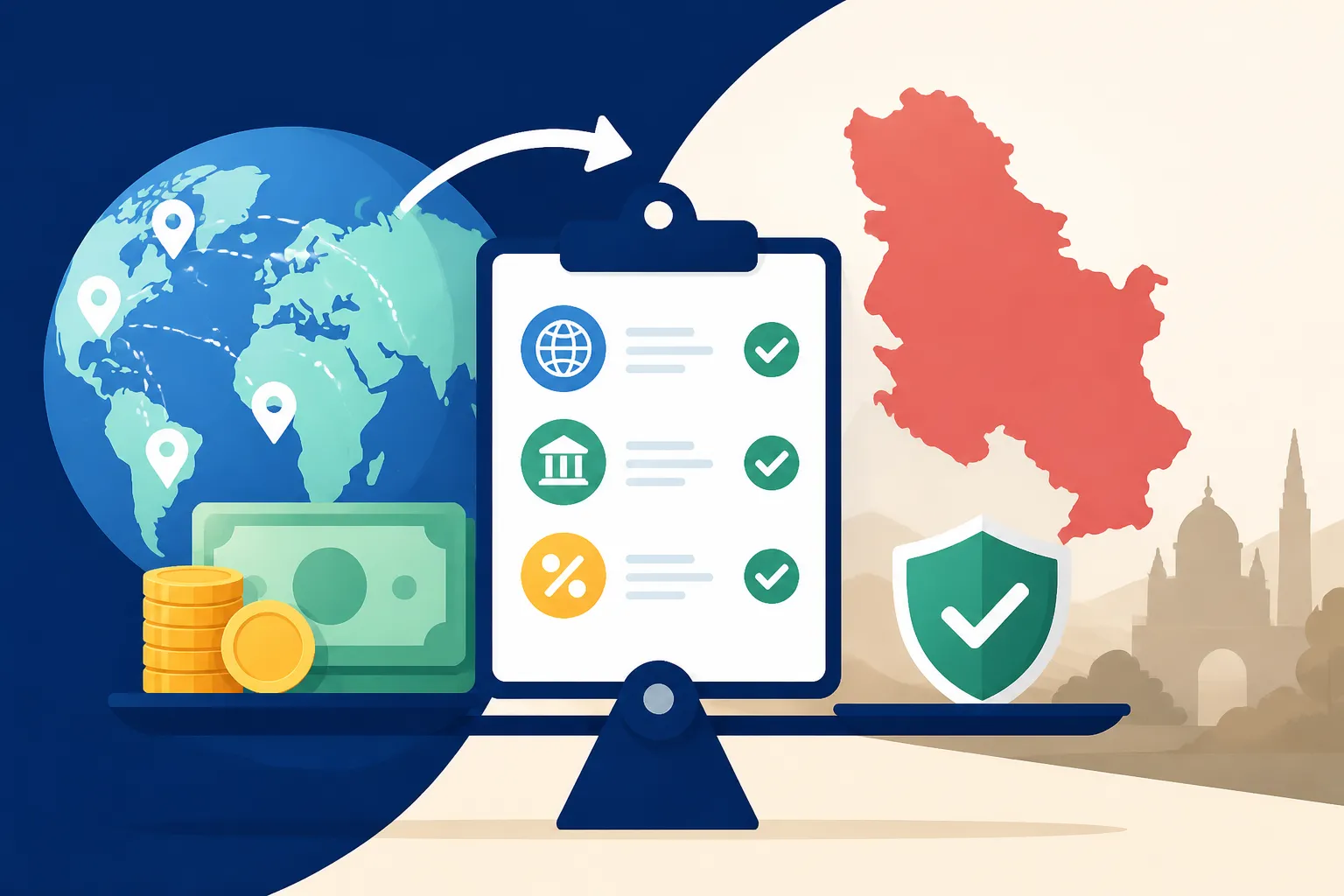
This is often the part that sends shivers down an expat’s spine: the fear of paying tax on the same income twice. Thankfully, Serbia has mechanisms in place to prevent this, primarily through its network of double taxation treaties and unilateral relief measures.
Double Taxation Treaties (DTTs)
Serbia has signed Double Taxation Treaties with a significant number of countries worldwide. These agreements are designed precisely to prevent individuals and companies from being taxed twice on the same income in two different countries. For a full understanding, you'll want to read about Understanding Double Taxation Agreements and Foreign Income in Serbia.
How do they work in practice? DTTs typically stipulate which country has the primary right to tax a specific type of income (e.g., employment income, dividends, pensions). If both countries have a right to tax, the treaty usually provides a method for relief, most commonly through:
- Exemption Method: The income is taxed only in one of the countries and is exempt from tax in the other.
- Credit Method: The country where you are a tax resident (Serbia, in this case) will tax the foreign income but will allow you to credit the taxes you’ve already paid in the source country against your Serbian tax liability. This ensures you don't pay more than the higher of the two tax rates.
For instance, if you earn dividends from a company in a country with which Serbia has a DTT, and that country withheld 5% tax on your dividends, the DTT might allow Serbia to tax the remaining amount but provide a credit for the 5% already paid. Always check the specific DTT relevant to your situation, as the details can vary significantly from one country to another. This is where getting professional advice, potentially from services like Taxes for Expats, can be invaluable, as deciphering these treaties can be like reading ancient hieroglyphs for the uninitiated.
The Serbian Tax Return and Reporting Foreign Income
As a tax resident, you are obliged to file an annual personal income tax return (Poreska Prijava) if your total annual income exceeds a certain threshold. For the year 2023, this threshold was approximately 3,719,376 RSD (roughly three times the average annual salary). If your combined income from both Serbian and foreign sources goes over this amount, you must file. You can learn more about this in our guide on How to File Your Annual Tax Return in Serbia.
The Poreska Uprava primarily uses an online portal called ePorezi for tax declarations. You'll need a qualified electronic signature to access and use this system, which can be a bit of a process to obtain initially but is essential for all electronic communication with the tax authorities.
When filing, you will need to declare all your worldwide income, categorising it appropriately. For foreign-sourced income, you’ll typically need to provide details of:
- The source country
- The type of income
- The gross amount received
- Any taxes withheld or paid in the source country
- Proof of taxes paid abroad (e.g., tax certificates, bank statements showing deductions).
If a DTT applies and provides for an exemption, you’ll still declare the income but claim the exemption. If it allows for a tax credit, you’ll declare the income and claim the credit for taxes paid abroad. The Poreska Uprava will then calculate your final Serbian tax liability, taking into account the DTT provisions. This entire process is covered in detail in our comprehensive guide, The Complete Guide to Taxes in Serbia for Expats (2027).
Practical Tips for Managing Foreign Income
Dealing with foreign income in a new country can be tricky, so here are a few hard-earned tips from an expat who’s been there:
- Keep Meticulous Records: This cannot be stressed enough. Keep every bank statement, every payslip (even if from a foreign employer), every dividend statement, every crypto transaction record, and every tax certificate from abroad. When the Poreska Uprava asks for proof, you'll be glad you have it neatly organised.
- Currency Conversion: Many expats receive income in Euros, USD, or other currencies. For tax purposes in Serbia, all foreign income must be converted to Serbian Dinars (RSD) using the official middle exchange rate of the National Bank of Serbia on the day the income was received, or on the last day of the accounting period, depending on the income type. Services like Wise can be incredibly useful here, not just for exchanging money at favourable rates but also for providing clear transaction records that can help with your conversions. How to Transfer Money Into and Out of Serbia as an Expat can give you more insights here.
- Seek Professional Advice: While this guide provides a solid overview, every expat's financial situation is unique. What applies to one person's pension might not apply to another's capital gains. For complex situations, especially if you have income from multiple sources or countries without DTTs, consulting with a local Serbian tax accountant or a specialist firm like Taxes for Expats is highly recommended. They can help you register with How to Register with the Tax Administration (Poreska Uprava) in Serbia and ensure your declarations are compliant.
- Plan Ahead for Social Contributions: If you are self-employed and receiving income from abroad, those mandatory social contributions can be a significant portion of your expenses. Make sure you factor them into your budget. They are crucial for your access to public healthcare and future pension benefits in Serbia.
Navigating the tax landscape for foreign-sourced income in Serbia doesn't have to be a nightmare. With a clear understanding of tax residency, the different income categories, and the benefits of double taxation treaties, you can confidently manage your finances and enjoy your life in this wonderful country without unnecessary tax stress.
Disclaimer
The information provided in this article is for general informational purposes only and does not constitute legal, financial, or tax advice. While we strive to provide accurate and up-to-date content, tax laws and regulations are subject to change and can be complex. We strongly recommend consulting with a qualified Serbian tax professional or legal advisor for advice tailored to your specific situation. Reliance on any information in this article is solely at your own risk.