Understanding Tax Residency Rules and the 183-Day Test in Serbia
Navigating the world of taxes as an expat in Serbia can feel like trying to solve a Rubik's Cube blindfolded, especially when it comes to understanding where you’re actually considered a tax resident. It's not just about paying your dues; it's about knowing which country gets to claim a slice of your global income. This guide will meticulously break down Serbia's tax residency rules, including the critical 183-day test, helping you figure out your obligations and, hopefully, avoid any nasty surprises down the line.
The Labyrinth of Serbian Tax Residency: Why It Matters
When you first arrive in Serbia, you're probably focused on finding an apartment, setting up utilities, and maybe even getting a handle on the local grocery stores. Tax residency often feels like a problem for "later." But trust me, understanding this from the get-go can save you a world of headaches, and potentially a good chunk of change, further down the line.
What Exactly is Tax Residency and Why Should You Care?
At its core, tax residency determines where you are primarily obligated to pay your taxes. It's a fundamental concept that dictates the scope of your tax liability. If Serbia considers you a tax resident, generally, you'll be taxed on your worldwide income here. This means income from your job in Belgrade, but also rental income from a property back home, dividends from foreign investments, or even income from a remote client abroad. On the other hand, if you're deemed a non-resident for tax purposes, you'll typically only be taxed on income sourced within Serbia. This distinction is absolutely massive for your financial planning.
The lines can get blurry, especially for digital nomads, remote workers, or those who travel frequently between countries. Many expats mistakenly assume their residency status for immigration purposes (like a temporary boravak permit) automatically means they are a tax resident. These are two completely separate things, governed by different laws and criteria. Your immigration status might grant you the right to live here, but tax residency is all about where your economic and personal ties lie according to the tax authorities.
The Real-World Impact on Your Wallet and Peace of Mind
Let's not sugarcoat it: getting your tax residency wrong can lead to serious consequences. Imagine thinking you're only taxable on your Serbian income, only to find out years later that the Poreska Uprava (the Serbian Tax Administration) believes you owe taxes on all your foreign earnings, plus penalties and interest. This isn't just a hypothetical scenario; it's a very real stressor many expats unfortunately face.
The financial implications are obvious: higher tax bills, potential fines, and the sheer cost of untangling a mess that could have been avoided. But beyond the money, there's the significant mental toll. The anxiety of non-compliance, the fear of audits, and the frustration of dealing with bureaucracy in a foreign language can be incredibly draining. Understanding your status clearly means you can properly budget, plan your investments, and sleep soundly knowing you're compliant. It also empowers you to leverage any Double Taxation Agreements (DTAs) that might be in place between Serbia and your home country, ensuring you're not taxed twice on the same income. This proactive approach is key to managing your finances effectively as an expat.
Deciphering the 183-Day Rule: Serbia's Primary Test
When the Poreska Uprava starts to look at whether you're a tax resident, one of the first things they'll do is whip out their calendar. The 183-day rule is often the simplest and most straightforward test, but even this seemingly clear-cut rule has its nuances.
How the Calendar Works: Counting Your Days in Serbia
The 183-day rule in Serbia refers to physical presence. Simply put, if you spend 183 days or more in Serbia within any 12-month period that overlaps with the tax year, you are generally considered a tax resident. It's not necessarily about a calendar year (January to December); it's about any continuous 12-month span. This is where it gets tricky because it requires you to track your movements carefully.
Every day you are physically present in Serbia, even a partial day, generally counts towards that 183-day threshold. This includes arrival and departure days. So, if you fly in on January 1st and leave on July 1st, that's already a good chunk of days. What often catches people out is not keeping meticulous records. Those quick weekend trips out of the country, or short visits back home for holidays, all break up your physical presence, but you still need to count the days you were here. The 12-month period can be confusing – it doesn't have to align with the calendar year. For example, if you arrive in September 2024 and stay until April 2025, those days will be counted across two calendar years but form part of a single 12-month period for residency calculation.
Beyond the Calendar: When 183 Days Isn't the Whole Story
While the 183-day rule is a primary indicator, it's not always the sole determining factor. There are situations where you might spend less than 183 days in Serbia, but still be considered a tax resident, or conversely, spend more than 183 days but argue you're not a tax resident. This usually comes into play when there are competing claims for your tax residency from another country, or when your ties to Serbia are exceptionally strong, even with fewer physical days.
The Serbian tax law doesn't just stop at counting days. It also looks at your "center of vital interests." This is a qualitative test designed to assess where your deepest personal and economic ties lie. So, if you spend 150 days in Serbia but your entire family lives here, your primary residence is here, your business operates here, and all your social life is here, the tax authorities might still consider you a resident, even if you technically fell short of the 183-day count. This is why a holistic view is always necessary, and simply adhering to the day count isn't always enough to guarantee non-residency if all other aspects of your life are firmly rooted in Serbia. This is also where an expat advisory service like Taxes for Expats can really help clarify your unique situation.
The "Center of Vital Interests" Test: A Deeper Dive
Okay, so we've established that just counting days isn't always enough. The Serbian tax authorities, much like many others around the world, also want to know where your "center of vital interests" lies. This is a much more subjective, yet incredibly important, test. It's about painting a picture of your life and figuring out which country holds the strongest pull for you, both personally and financially.
Family Ties and Personal Connections: What the Taxman Looks At
When it comes to personal connections, the Poreska Uprava will look at various indicators that suggest where your true home is. Do you have a spouse or children living with you in Serbia? Are they enrolled in local schools like the International School of Belgrade or local domovi zdravlja (health centers)? These are strong indicators of personal ties. If your family is here, it's a pretty clear sign that your life is deeply rooted in Serbia, regardless of how many business trips you take.
Beyond immediate family, they'll also consider your social life. Are you actively involved in local clubs, sports teams, or community groups? Do you have a wide circle of friends here? Do you regularly attend local cultural events or have memberships to gyms, theatres, or other institutions? These aren't just minor details; they collectively build a case for where you spend your non-working hours and where your personal life unfolds. If your significant other, kids, friends, and hobbies are all firmly established in Serbia, it becomes much harder to argue you’re not a resident, even if your job takes you away for stretches of time.
Economic Connections: Where Your Money and Business Reside
Your financial footprint is another massive piece of the puzzle. Where do you earn your primary income? Is it from a Serbian employer, or are you operating a business registered here? If you're a self-employed entrepreneur, is your preduzetnik (sole trader) or DOO (limited liability company) registered in Serbia? These are significant economic ties.
Furthermore, they'll look at your assets. Do you own property in Serbia, either your primary residence or investment properties? Do you have bank accounts with Serbian banks like Banca Intesa or Raiffeisen Bank, and are these accounts where your primary funds flow? Are your investments managed here, or do you receive significant income (like rental income, dividends, or capital gains) from Serbian sources? Even the presence of a Serbian driver's license, car registration, or utility bills in your name for a long-term rental contribute to this picture. If most of your financial life is structured around Serbia, it strongly suggests your economic center of vital interests is here. Transferring money in and out of the country, for instance, through services like Wise, can be monitored as part of your financial activity, so maintaining clear records is crucial.
Navigating Dual Residency and Double Taxation Agreements (DTAs)
One of the biggest anxieties for expats is the dreaded "dual residency." It sounds complicated, and frankly, it often is. But understanding how it happens and how international agreements can help is essential.
When Two Countries Claim You: The Headache of Dual Residency
Dual residency occurs when two different countries, based on their respective domestic laws, both consider you a tax resident. For example, your home country might consider you a tax resident because you maintain a permanent home there and have strong family ties, while Serbia considers you a resident because you've met the 183-day rule and established your center of vital interests here. Suddenly, you're in a situation where both countries believe they have the right to tax your worldwide income – a truly frustrating scenario.
This is a common pitfall for expats who might spend significant time in both their home country and Serbia, or who have substantial ties in both. The confusion often leads to incorrect tax filings or, worse, accidental non-compliance in one or both jurisdictions. Without understanding how to resolve this, you could end up paying more tax than necessary, or facing penalties from either tax authority. It's a bureaucratic nightmare that requires careful navigation, often with professional help. This is where the intricacies of international tax law come into play, which can feel incredibly overwhelming when you’re just trying to live your life.
Serbia's DTA Network: Your Shield Against Double Taxation
Thankfully, there's a mechanism in place to prevent this exact scenario: Double Taxation Agreements (DTAs). Serbia has an extensive network of DTAs with many countries around the world. These bilateral agreements are designed precisely to avoid situations where an individual or company is taxed twice on the same income by two different states. DTAs override domestic tax laws when there's a conflict regarding residency.
When dual residency arises, DTAs contain "tie-breaker rules" that help determine which country has the primary right to tax your income. These rules follow a specific hierarchy:
- Permanent Home: You are deemed a resident of the country where you have a "permanent home available to you." This isn't just about ownership; it could be a rented apartment that's always available.
- Centre of Vital Interests: If you have a permanent home in both countries (or neither), the DTA will look to where your personal and economic relations are "closer." This goes back to our discussion about family, social life, employment, and assets.
- Habitual Abode: If the above two are inconclusive, they'll look at where you "habitually" live, meaning where you spend more time.
- Nationality: If all else fails, your nationality might be used as a tie-breaker.
- Mutual Agreement: In rare cases, if all else is inconclusive, the tax authorities of both countries will consult each other to reach a mutual agreement.
Understanding the specific DTA between Serbia and your home country is paramount. These agreements dictate not only who gets to tax your worldwide income but also provide rules for specific income types (e.g., pensions, dividends, employment income) to ensure fair treatment. You can usually find the text of these DTAs on the website of the Serbian Ministry of Finance or your home country's tax authority. For complex situations, it’s invaluable to consult with experts who specialize in international tax, such as those at Taxes in Serbia for Expats or a global expat tax service.
Practical Steps to Determine and Prove Your Tax Residency
So, how do you actually go about proving your tax residency, or indeed, determining it with certainty? It requires a bit of detective work and meticulous record-keeping. The Poreska Uprava won't just take your word for it; they want to see concrete evidence.
Gathering Your Evidence: What the Poreska Uprava Wants to See
The key to navigating tax residency is documentation. Assume that at some point, you might need to prove your case. This means proactively collecting and organizing documents that support your claim, whether you believe you are a tax resident of Serbia or of another country.
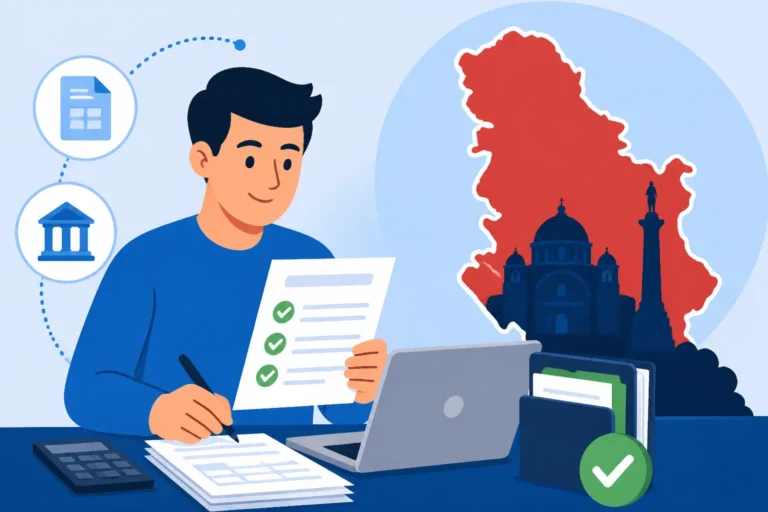
Here's a list of essential documents and records you should keep:
- Proof of Physical Presence: This is crucial for the 183-day test. Keep copies of all entry and exit stamps in your passport, flight tickets, train tickets, or even border crossing receipts. A meticulously maintained personal calendar noting your location each day can also be helpful.
- Residential Proof: Your rental agreement (signed and notarized, if applicable) or property ownership deeds in Serbia. Also, collect utility bills (electricity from EPS, water, heating) in your name, internet bills, and mobile phone contracts. These demonstrate a fixed abode.
- Financial Records: Bank statements from Serbian banks (Banca Intesa, Raiffeisen Bank, OTP Bank, etc.) showing your transactions and account activity. If you’re a freelancer or entrepreneur, business registration documents and invoices issued from Serbia are important. Records of international money transfers, perhaps through a service like Wise, can also show your financial ties.
- Employment/Business Records: Employment contracts with Serbian companies, pay slips, and confirmation of social security contributions. If self-employed, your preduzetnik registration certificate and tax payment records (for the pausal regime, for example) are vital.
- Personal Ties: Marriage certificates, birth certificates of children, school enrolment documents for your children, gym memberships, club memberships, medical records from your GP (izabrani lekar) at a local Dom Zdravlja, and anything else that shows your social and family integration in Serbia.
- Communications: Official correspondence from Serbian institutions (banks, MUP, Poreska Uprava, local government) sent to your Serbian address.
The more comprehensive and organized your documentation, the stronger your position will be if questions about your tax residency arise. Remember, the burden of proof often falls on the individual.
Seeking Professional Guidance: When to Call in the Experts
While this guide aims to be comprehensive, tax laws are incredibly complex, and every expat's situation is unique. There comes a point when trying to decipher it all on your own becomes a false economy. This is especially true if you have income from multiple countries, own property in different jurisdictions, or spend significant time bouncing between Serbia and another country.
An experienced tax advisor specializing in international tax for expats can:
- Provide a definitive assessment: They can analyze your specific circumstances against both Serbian domestic law and any relevant DTAs to give you a clear determination of your tax residency status.
- Help with compliance: They can guide you through the process of filing your tax returns correctly in Serbia, ensuring you declare all necessary income and claim any eligible deductions or credits.
- Resolve dual residency issues: If you are considered a tax resident in two countries, they can help you invoke the DTA tie-breaker rules and obtain a tax residency certificate from the relevant authority.
- Offer strategic advice: They can advise you on how to structure your finances or physical presence to align with your desired tax residency outcome, all within legal frameworks.
While it's an investment, the peace of mind and potential savings from avoiding penalties or overpayment often far outweigh the cost of professional advice. Services like Taxes for Expats or local Serbian accountants with international experience are excellent resources for this. For guidance on your tax obligations, you might also find insights in articles such as The Complete Guide to Taxes in Serbia for Expats (2027) or Understanding Income Tax and the Flat 10% Rate in Serbia (2026).
The Consequences of Getting It Wrong: Penalties and Pitfalls
Nobody wants to deal with tax authorities, especially in a foreign country. But ignoring your tax residency status in Serbia, or simply getting it wrong, can lead to a whole host of unpleasant consequences that far outweigh the initial effort of understanding it properly.
The Risks of Non-Compliance: What Could Go Wrong
The Poreska Uprava is becoming increasingly sophisticated, particularly with international data exchange agreements. They will eventually catch up if you're non-compliant, and the repercussions can be severe.
Here's what you could be facing:
- Significant Fines and Penalties: Serbian tax law imposes substantial fines for late filing, incorrect declarations, or outright evasion. These fines are often a percentage of the unpaid tax, and they can add up quickly. It's not uncommon for penalties to exceed the original tax amount.
- Back Taxes and Interest: If it's determined that you should have been a tax resident and paid taxes on your worldwide income, you'll be liable for all the unpaid taxes from previous years. On top of that, you'll be charged interest on these amounts, which can accumulate significantly over time.
- Audits and Investigations: Non-compliance can trigger a full tax audit, which is a lengthy, stressful, and intrusive process. This involves providing extensive documentation and potentially facing interviews with tax officials, often requiring the assistance of a lawyer or tax professional, adding further costs.
- Legal Action: In severe cases of tax evasion, particularly involving larger sums, legal proceedings can be initiated, potentially leading to criminal charges. While rare for genuine mistakes, willful evasion is taken seriously.
- Reputational Damage: For entrepreneurs or business owners, a history of tax non-compliance can damage your reputation, making it harder to conduct business, secure loans, or even maintain your residency status in Serbia.
- Residency Issues: Repeated tax non-compliance could also impact your ability to renew your temporary residence permit (privremeni boravak) or apply for permanent residence in Serbia, as good standing with government authorities is generally a requirement. You can learn more about this in our guide on How to Get Temporary Residence (Boravak) in Serbia (2027).
It's a scary list, but it's important to understand the gravity of the situation. Ignorance of the law is generally not considered an excuse, so taking the time to educate yourself now is truly an investment in your future.
Avoiding Common Traps: Lessons from Fellow Expats
I've seen many expats get caught out over the years, often due to misunderstandings or assumptions. Here are some common traps and how to avoid them:
- The "Tourist Visa" Trap: Some expats assume that if they enter on a tourist visa or a visa-free entry, they can stay for extended periods and simply leave before the 90-day mark (within 180 days) and re-enter, thinking they've "reset" their tax clock. This is an immigration tactic, not a tax residency solution. The 183-day tax rule often looks at any 12-month period, not just a calendar year, and your center of vital interests remains a factor regardless of your visa status.
- Ignoring Foreign Income: Believing that because your income is from abroad, it's not taxable in Serbia. If you are a Serbian tax resident, your worldwide income is generally taxable here. You must declare it, even if a DTA provides relief. Read more about this in Understanding the Tax Treatment of Foreign Income in Serbia.
- Not Keeping Records: Failing to keep meticulous records of your entry/exit dates, financial transactions, and any documents supporting your ties to another country. This becomes critical if you ever need to prove your case.
- Assuming "Everyone Else Does It": Relying on anecdotal advice from other expats who might have different situations or are simply taking risks. What works (or seems to work) for one person might be disastrous for another. Always consult reliable sources or professionals.
- Not Understanding DTAs: Many expats know about DTAs but don't bother to read the specific agreement relevant to them. These agreements are not all identical, and the tie-breaker rules need to be applied precisely.
- Ignoring Small Payments: Thinking that small, irregular freelance payments from abroad don't need to be declared. If you're a tax resident, all income counts, no matter how small or infrequent.
The best way to avoid these pitfalls is to be proactive, get educated, and when in doubt, consult a professional. It's a bit of work upfront, but it ensures your time in beautiful Serbia remains stress-free and financially sound. Utilizing services like Wise for international transfers can also help with record-keeping by providing clear transaction histories, which can be useful documentation.
Here's a handy table summarizing the key aspects of Serbian tax residency:
| Feature | 183-Day Test | Center of Vital Interests Test |
|---|---|---|
| Criterion | Physical presence in Serbia | Deepest personal and economic ties to Serbia |
| Measurement | 183 days or more within any 12-month period overlapping the tax year | Qualitative assessment of various factors |
| Key Indicators (Days) | Entry/exit stamps, flight/travel records, physical location tracking | Family location, social activities, property ownership, employment/business, bank accounts |
| Purpose | Primary quantitative test for tax residency | Secondary qualitative test, often used for tie-breaking or strong ties |
| Importance | High, often the first and simplest test | High, especially if the 183-day test is inconclusive or contradictory |
| Documentation Needed | Passport, travel tickets, personal calendar | Rental agreements, utility bills, bank statements, employment contracts, family documents, club memberships |
| Considerations | Consecutive vs. non-consecutive days, partial days count | Subjective, comprehensive view needed, can override day count |
| Outcome if Met | Likely tax resident (subject to DTA tie-breakers) | Likely tax resident (subject to DTA tie-breakers) |
Disclaimer
The information provided in this article is for general informational purposes only and does not constitute professional tax, legal, or financial advice. Tax laws are complex and subject to change. It is highly recommended that you consult with a qualified tax advisor or legal professional specializing in Serbian and international tax law for advice tailored to your specific situation. The author and publisher are not liable for any actions taken or not taken based on the content of this article.