What Happens If I Get Sick Before I Register with the RFZO in Serbia?
Alright, let's talk about one of those lurking fears that probably keeps many of us expats up at night: getting sick in a new country before you've even had a chance to navigate the bureaucratic maze of healthcare registration. It's a completely valid anxiety. You've just arrived in Serbia, you're trying to get settled, learn a few phrases, maybe even tackle your How Do I Register My Address (Prijava) in Serbia? – and then, bam, you wake up with a fever, a nasty cough, or worse. Suddenly, the official Republic Health Insurance Fund (RFZO) system feels a million miles away. This guide is here to cut through the stress, explain exactly what your options are, what you can expect, and how to handle medical situations if you find yourself unwell before you’re officially registered.
The Reality of Unregistered Healthcare in Serbia And Why It's Stressful
It's a universal expat experience: arriving in a new country, full of optimism, only to be confronted by a healthcare system that's completely different from what you're used to. In Serbia, the cornerstone of public healthcare is the RFZO, or Republički Fond za Zdravstveno Osiguranje. This is the national health insurance fund, and once you're properly registered and paying your contributions, it grants you access to most public healthcare services at a minimal cost. But what if you haven't gotten there yet? What if you're still waiting for your residence permit, or simply haven't had the time to complete the registration?
Understanding Your Status: Tourist vs. New Resident
The fundamental distinction here, before you've registered with the RFZO, is that you are essentially treated as either a tourist or a private patient. This means you do not have the benefits of state-subsidized care that registered residents enjoy. Think of it this way: the doors to the public dom zdravlja (health centre) and public hospitals are still there, but you'll be footing the bill directly, much like if you were visiting from abroad.
The RFZO system, as detailed in guides like How Serbia's Health System Works: The RFZO and Private Care Explained (2027), relies on you being part of the system. Without that, you're outside the standard procedure for getting an izabrani lekar (chosen doctor) or a referral. This isn't to say you'll be left to suffer on the streets, but it does mean a different pathway and, crucially, a different cost structure.
The Immediate Steps: What to Do First
The very first thing you need to do is not to panic. Seriously, take a deep breath. Getting stressed won't help your symptoms. The Serbian healthcare system, while it can seem daunting from the outside, is designed to provide care. Your immediate action depends on the severity of your condition.
Ask yourself: Is this a genuine emergency, something life-threatening or requiring immediate medical intervention? Or is it a milder ailment, like a bad cold, flu, or a minor injury, which can wait a few hours or a day for a doctor's appointment? This distinction will dictate your next steps. For anything truly urgent, the priority is getting immediate help, regardless of your RFZO status. If it's something less severe, you have a bit more time to consider your options, which often means heading straight to a private clinic where language barriers are less common and appointments are easier to secure. Don't hesitate to reach out to a trusted local friend or colleague if you have one; their advice and assistance in making calls can be invaluable.
Accessing Medical Care Without RFZO Coverage
When you're not yet plugged into the RFZO system, your options for medical care become a clear split between public emergency services and private clinics. Both have their place depending on your situation, and it's vital to understand the nuances of each.
For Emergencies: Calling 194 and Public Hospitals
Let's start with the absolute critical situations. If you're experiencing a severe medical emergency – think chest pain, serious injury, sudden severe illness, or anything that feels life-threatening – you should absolutely call the emergency services. The number to remember is 194 for an ambulance directly, or 112 for a general emergency, which will then direct you to the appropriate service. Don't hesitate.
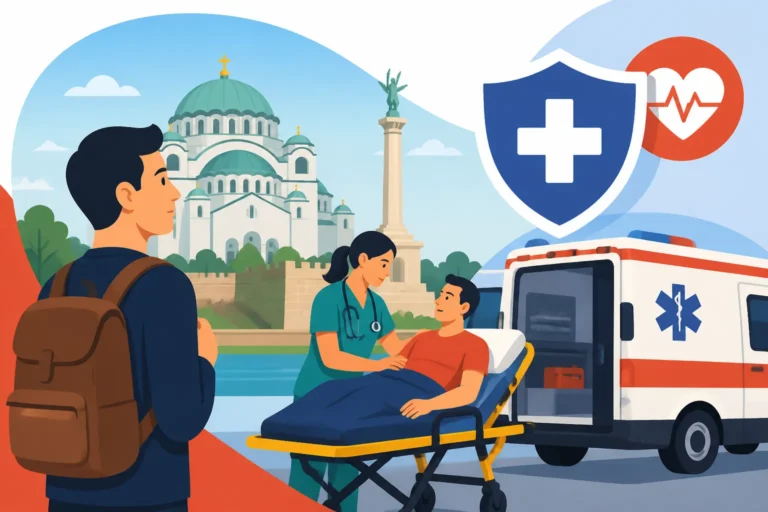
When the ambulance arrives, they will assess your condition and transport you to the nearest appropriate public hospital. Here's a crucial point: public hospitals in Serbia will treat true medical emergencies regardless of your insurance status. They are legally obligated to provide life-saving care. However, while initial treatment will be provided, you will very likely be billed for the services rendered. This means that once you are stable, or after the emergency has passed, you or your insurance provider will be responsible for the costs. This is something often discussed in our guide on Emergency Medical Care in Serbia: What Every Expat Needs to Know. Be prepared for potential language barriers in public hospitals, as not all staff may speak English fluently, especially outside of Belgrade's larger institutions. If possible, have someone with you who speaks Serbian.
For Non-Emergencies: Private Clinics and Doctors
For anything that isn't an immediate, life-threatening emergency, private clinics will become your best friend. This is often the go-to choice for expats in Serbia, even those with RFZO, due to convenience, language support, and generally shorter wait times. Private clinics operate on a pay-as-you-go basis, meaning you will pay for each consultation, test, or procedure directly.
Belgrade and Novi Sad, in particular, boast numerous reputable private healthcare chains such as Medigroup, Euromedik, and Bel Medic. These clinics typically have English-speaking staff, offer a wide range of specialist services under one roof, and often have more modern facilities and equipment. You can usually call ahead to book an appointment, sometimes even on the same day, which is a huge relief when you're feeling unwell. For a minor illness, like a bad cold, a gastrointestinal bug, or a skin rash, a private GP consultation is often the quickest and most comfortable route to diagnosis and treatment. Finding an English-speaking doctor in Serbia is definitely easier through these private networks.
While the care quality is often high, the trade-off is the cost. A basic consultation with a general practitioner can range from 3,000 to 6,000 RSD, and specialist consultations, diagnostic tests, or medications will add to that. Always ask about the price upfront if you're concerned.
The Role of Travel and Private International Health Insurance
This is where your preparedness truly pays off. If you're a new arrival and haven't registered with the RFZO, having robust travel insurance or a comprehensive private international health insurance plan is absolutely critical.
Many expats rely on robust travel insurance or specific expat insurance like SafetyWing during this transitional period. Travel insurance policies are designed to cover unexpected medical emergencies and illnesses while you're abroad for a shorter duration. They can cover ambulance rides, hospital stays, and even emergency repatriation if needed. It’s imperative to check the details of your travel insurance policy before you travel, specifically looking for medical coverage limits, exclusions, and the process for making claims or getting direct billing in Serbia. Some policies might require you to pay upfront and then seek reimbursement.
For those planning a longer stay but are still in the process of getting their RFZO sorted, or perhaps even prefer private care long-term, a private international health insurance plan is a must. Companies like SafetyWing offer plans specifically tailored for digital nomads and expats, providing coverage that extends beyond typical travel insurance. These policies can cover routine doctor visits, specialist care, and even hospitalizations, offering a safety net until (or if) you register with the RFZO. When choosing a provider, whether it's for travel insurance or a long-term expat plan, check if they offer direct billing in Serbia or if you'll need to pay upfront and claim later. Providers like SafetyWing often have clear processes for this, which can save you a lot of hassle. Understanding the nuances of Understanding Private Health Insurance Plans in Serbia can help you make an informed decision about your coverage.
Here's a quick comparison of your options without RFZO:
| Feature | Public Emergency Services (via 194/112) | Private Clinics (for non-emergencies) |
|---|---|---|
| Urgency | Life-threatening emergencies | Non-urgent illnesses, routine care |
| Access | Immediate, 24/7 | By appointment, often same-day |
| Cost | Will be billed, potentially high | Pay-as-you-go, clear pricing |
| Language | May be a barrier, reliance on Serbian | Often English-speaking staff |
| Facilities | Varies, can be older | Generally modern, well-equipped |
| Insurance Req. | None for initial emergency treatment | Crucial for reimbursement |
| Benefit | Saves lives | Convenience, comfort, language |
Managing Costs and Post-Treatment Steps
Getting medical attention is one thing; navigating the financial aftermath is another, especially when you're caught off guard without RFZO coverage. But with a bit of foresight and diligent record-keeping, you can manage the costs effectively.
Understanding Out-of-Pocket Expenses
When you visit a private clinic in Serbia without RFZO, you're looking at entirely out-of-pocket expenses unless you have private insurance. The costs can vary significantly depending on the clinic, the doctor's specialty, and the complexity of your issue. For instance, a general practitioner consultation might cost between 3,000 and 6,000 RSD (roughly 25-50 EUR). If you need blood tests, urine analysis, an X-ray, or ultrasound, each of these will be an additional charge. Specialist consultations, like seeing a dermatologist or a gastroenterologist, typically range from 5,000 to 10,000 RSD.
Medications also fall into this category. While Serbia generally has affordable medications, as highlighted in Prescription Medications and Pharmacies in Serbia: The Complete Guide, you'll pay the full price for any prescribed drugs. Always ask for an itemized receipt for every service and payment. This isn't just good practice; it's absolutely essential for any potential insurance claims later. Most clinics accept card payments, but it's always wise to have some cash on hand, just in case, especially for smaller pharmacies or if a card machine is down.
Claiming Reimbursement from Your Insurance (If Applicable)
If you were smart enough (or lucky enough!) to have travel insurance or private international health insurance like SafetyWing, this is the time to leverage it. The process of claiming reimbursement will depend entirely on your specific policy, so referring to your policy documents is paramount.
Generally, the steps involve:
- Notify your insurer: Contact your insurance provider as soon as reasonably possible after receiving treatment. Many policies have a strict timeframe for notification.
- Gather documentation: This is where those itemized receipts and medical reports come into play. You'll need proof of payment, a diagnosis from the doctor, details of the treatment received, and any prescriptions. The more detailed, the better.
- Submit your claim: Follow your insurer's specific procedure for submitting a claim, which often involves filling out forms and uploading supporting documents through an online portal or sending them via email.
- Follow up: Don't be afraid to follow up if you haven't heard back within a reasonable timeframe.
Having private insurance can significantly mitigate the financial burden of unexpected illness. Remember, even if you eventually plan to rely on the RFZO, having this private coverage for your initial settling-in period in Serbia is a smart move. It offers peace of mind and financial protection during a time when you're likely already dealing with numerous other relocation expenses. For more on what these costs might look like, check out The Cost of Healthcare in Serbia: A Complete Breakdown for Foreigners (2026).
Preventing Future Stress: Expediting Your RFZO Registration
While dealing with an unexpected illness before RFZO registration can be managed, the ideal scenario is to get registered as quickly as possible. This removes a huge layer of stress and provides access to the broader Serbian public healthcare system.
The RFZO Registration Process Simplified Overview
Registering with the RFZO is one of those administrative tasks that feels like climbing Mount Everest when you first arrive, but it's entirely manageable with a bit of persistence. In essence, it involves proving your legal residence and, if applicable, your employment status in Serbia. The specific documents you'll need can vary slightly based on your residence status (e.g., employed, self-employed, family reunification, student), but generally include:
- Your passport
- Your residence permit (boravak)
- Proof of address registration (bela karta or similar)
- Proof of employment or self-employment registration (for those working)
- A completed RFZO application form
The process usually begins at a local branch of the RFZO, often in conjunction with registering with a general practitioner at a dom zdravlja. Our dedicated guide, How to Register with the Republic Health Insurance Fund (RFZO) in Serbia, breaks down every step in detail, including the critical information on What Is the RFZO and How Does It Work in Serbia?. While it can take some time to gather all the documents and navigate the offices, it's a worthwhile investment in your long-term well-being and financial security in Serbia.
Bridging the Gap: Short-Term Solutions While You Wait
Even after you've submitted your RFZO application, there's often a waiting period before your health card is issued and your coverage becomes active. This "gap" period is precisely why having a reliable short-term solution is so important.
Your best bet here is to maintain your private international health insurance or travel insurance during this time. As mentioned earlier, providers like SafetyWing offer flexible plans that can be renewed monthly, ensuring continuous coverage. This way, if you need medical attention while your RFZO application is processing, you're still protected from significant out-of-pocket expenses. It's a smart strategy to cover yourself from the moment you land until you have your RFZO card firmly in your hand. Knowing How to Register with the RFZO and a GP in Serbia (2027) can give you a head start, but these interim solutions are equally important.
Proactive Health Measures
Beyond insurance and registration, there are several proactive steps you can take to minimize health-related stress during your initial months in Serbia:
- Pack Essential Medications: Bring a supply of any prescription medications you regularly take, along with copies of your prescriptions. Also, pack a basic first-aid kit with pain relievers, cold and flu remedies, and any over-the-counter medications you rely on.
- Learn Basic Health Phrases: Knowing how to say "I'm sick," "doctor," "pharmacy," or describe basic symptoms in Serbian can be incredibly helpful in an emergency or when communicating with non-English speaking staff.
- Have a Local Contact: If you know someone in Serbia – a friend, colleague, or even your landlord – share your health situation with them if you feel comfortable. Having someone who can make calls in Serbian or accompany you to an appointment can make a world of difference.
- Know Your Options: Understand the difference between public and private healthcare in Serbia, as covered in Public vs Private Healthcare in Serbia: What Expats Need to Know, so you can make informed decisions quickly if illness strikes.
- Understand Out-of-Pocket Costs: Familiarize yourself with Understanding Out-of-Pocket Healthcare Costs and Co-Payments in Serbia to have a realistic expectation of expenses if you need to pay privately.
By taking these steps, you not only prepare for the worst but also gain confidence in navigating the Serbian healthcare landscape. It might seem like a lot to take in, but remember, countless expats have walked this path before you, and you'll find your way too.
Disclaimer
The information provided in this article is intended for general informational purposes only and does not constitute medical, legal, or professional advice. While we strive to provide accurate and up-to-date information, healthcare regulations, procedures, and costs in Serbia can change. Always consult with a qualified medical professional for health concerns and with an immigration expert or legal professional for specific advice regarding your residence and healthcare registration in Serbia. Relying solely on the information presented here is at your own risk.