How Much Does It Cost to Run a Car in Serbia per Month?
Moving to a new country like Serbia often brings a mix of excitement and practical concerns. One question that quickly comes to mind for many expats, especially those used to the freedom of their own wheels, is "How much does it actually cost to run a car here every month?" You're not alone in wondering this; navigating the expenses of vehicle ownership in a new administrative system can be a real head-scratcher. This comprehensive guide will break down all the typical monthly costs you can expect, helping you budget wisely and decide if driving in Serbia is right for you.
The Serbian Driving Dream vs. Reality: Initial Thoughts
For many of us, especially those who've lived in places where public transport is a distant dream or simply doesn't cut it for our lifestyle, the thought of having our own car in Serbia is incredibly appealing. It promises freedom, the ability to explore the stunning countryside, visit those hidden monasteries, or simply get to the supermarket without relying on a taxi or the often-packed bus. But, as with everything in a new country, that dream comes with a dose of practical reality and a fair few expenses.
Why You Might Want a Car Here (or Not)
Having a car in Serbia truly opens up the country in a way public transport simply can't. Imagine spontaneous road trips to Fruška Gora, exploring the vineyards, or heading south to the mountains whenever the mood strikes. For families, especially those with young children, a car is often seen as a necessity, making school runs, doctor appointments, and grocery shopping infinitely easier. Belgrade and Novi Sad have decent public transport, but step outside the city centres, or travel between towns, and you'll quickly realise the limitations. For someone who values independence and convenience, a car is a game-changer.
However, it's not always sunshine and open roads. City driving, particularly in Belgrade, can be a test of patience with heavy traffic, aggressive drivers, and notoriously tricky parking. If you mainly stick to the city centre and don't venture out much, you might find that the costs and hassles outweigh the benefits, especially when you consider how easy it is to How Do I Use Public Transport in Belgrade? or hail a taxi. It’s a personal calculation, balancing convenience against the financial outlay.
Understanding the Basics: It's Not Just Fuel
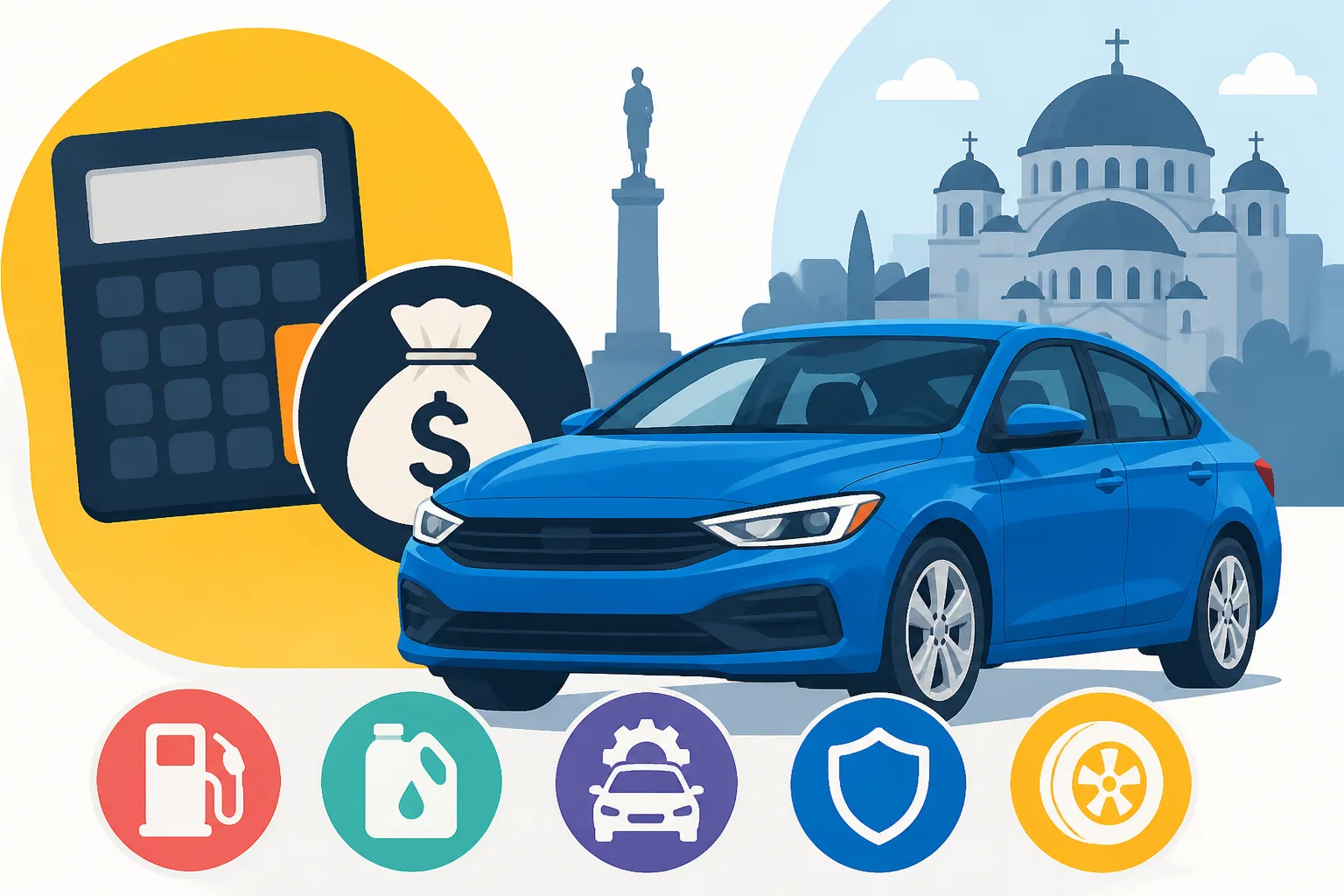
When people first think about car costs, fuel is often the first thing that springs to mind, and rightly so. But running a car is far more complex than just filling up the tank. We're talking about a whole ecosystem of expenses that quietly chip away at your budget each month. There's mandatory insurance, the annual registration fees that feel like a small tax on freedom, regular maintenance, and the looming possibility of unexpected repairs.
Then there are the more subtle costs: parking fees that add up, highway tolls for longer journeys, and even the seasonal expense of changing tires. The type of car you drive also plays a huge role; a small city car will naturally be cheaper to run than a large SUV. And let's not forget that costs can even vary depending on where you live. Running a car in downtown Belgrade with its parking zones and traffic will be different from owning one in a smaller town where parking is free and distances are shorter. This guide aims to pull back the curtain on all these elements, giving you a realistic picture.
Fuel Costs: The Most Obvious Expense
Let's start with the big one, the cost you feel most directly: fuel. Every time you pull into a petrol station, you're reminded of this recurring expense. Fuel prices in Serbia, like everywhere, fluctuate, but understanding the general landscape and your car's thirst is crucial for budgeting.
Petrol vs. Diesel vs. LPG
In Serbia, you'll primarily find three types of fuel: BMB 95 (petrol), Euro Diesel, and LPG (liquid petroleum gas). As of mid-2024, petrol prices for BMB 95 hover around 195 RSD per litre, while Euro Diesel is slightly more expensive, usually around 205 RSD per litre. LPG, on the other hand, is significantly cheaper, often costing around 90-100 RSD per litre. This makes LPG a very attractive option for those who drive a lot and whose cars are converted to run on it, though the conversion itself is an upfront cost.
Your driving habits will dramatically impact your monthly fuel bill. If you're mostly doing short city hops, constantly stopping and starting, your car will consume more fuel than if you're cruising on the highway. A typical mid-range petrol car might consume 7-9 litres per 100 km in mixed driving, while a diesel car might manage 5-7 litres per 100 km. If you're keen to keep track of the most up-to-date figures, checking How Much Is Petrol per Litre in Serbia in 2026? can give you a real-time snapshot. Major fuel stations like NIS Petrol, OMV, EKO, and Lukoil are widespread, and while prices are generally government-regulated, minor differences can be found. Keep an eye out for loyalty programs or discounts, especially if you stick to one brand.
Fuel Consumption: Your Car's Thirst
Let's talk about how much your car actually drinks. This isn't just a number on a spec sheet; it's a real-world factor that empties your wallet. For a common expat choice, say a smaller hatchback like a Fiat 500 or a larger sedan like a Škoda Octavia, the fuel consumption can range quite a bit. A compact city car might achieve 6 litres per 100 km in combined driving, while an older, larger SUV could easily hit 10-12 litres per 100 km. These figures are averages, and your actual consumption will vary.
Driving style is a massive contributor. Heavy acceleration, sudden braking, and excessive idling in traffic will all make your car thirstier. Using the air conditioning constantly, especially in Serbia's hot summers, also adds to consumption. To estimate your monthly fuel budget, consider your average monthly mileage. If you drive, say, 1,000 km a month in a petrol car that averages 8 litres/100 km, you're looking at 80 litres of fuel. At 195 RSD/litre, that's 15,600 RSD, which is roughly 130-135 EUR. This is often the largest single monthly running cost for most drivers.
Insurance and Registration: The Annual Hurdles, Monthly Bite
Beyond fuel, there are the unavoidable annual costs that, when broken down, become a significant part of your monthly car budget. These are mandatory expenses that keep you legal and insured on Serbia's roads.
Mandatory Car Insurance (AO Polisa)
Every vehicle in Serbia must have mandatory third-party liability insurance, known as AO polisa. This covers damage you might cause to another vehicle or property in an accident. The cost of this insurance isn't fixed; it depends on several factors, including your vehicle's engine size, your age as the primary driver (younger drivers often pay more), and your claims history. Generally, for a mid-range car, you might expect to pay anywhere from 15,000 RSD to 30,000 RSD annually.
While you pay for it once a year, it's essential to factor this into your monthly budget planning. For instance, a 24,000 RSD annual premium breaks down to 2,000 RSD per month. It’s not something you can skip, and proof of valid insurance is required for your annual registration. Understanding How Much Is Car Insurance in Serbia? can help you get a better grip on these figures.
Annual Vehicle Registration
Ah, registration! This is another one-time annual payment that feels like a multi-headed beast. Your annual vehicle registration covers several components: the road tax (putarina), public transport fees (if you're in a larger city like Belgrade or Novi Sad), an environmental tax, and an administrative fee. The total amount varies considerably based on your car's engine size (the bigger the engine, the higher the tax), its age, and its fuel type. For a standard 1.6-litre petrol car, you might pay between 25,000 RSD and 40,000 RSD annually. Diesel cars, especially older ones, can sometimes incur higher environmental charges.
Again, while this is paid once a year, it needs to be amortized across your monthly budget. A 36,000 RSD annual registration translates to 3,000 RSD per month. You can't avoid this, and keeping up with how to How Do I Renew My Car Registration in Serbia? is crucial to stay legal on the road. Remember, there's also the technical inspection fee bundled into this process, which we'll cover later.
Optional Additional Coverage
Beyond the mandatory third-party liability, many expats opt for additional insurance, most commonly comprehensive insurance, known as kasko in Serbia. This covers damage to your own vehicle, whether it's an accident you caused, theft, vandalism, or natural disasters. If you have a newer, more expensive car, or simply want peace of mind, kasko is highly recommended. The cost of kasko can vary widely, from a few hundred euros to over a thousand annually, depending on your car's value, make, model, and the coverage details.
Other add-ons might include roadside assistance, glass breakage coverage, or even specific cover for items stolen from your car. While these are not mandatory, they can significantly reduce stress and financial burden in case of an incident. Before committing to a policy, it’s worth shopping around and getting quotes from multiple providers to see what best suits your needs and budget. Weigh the extra monthly cost against the potential out-of-pocket expenses for repairs, especially if you're driving a car that would be costly to fix.
Maintenance and Repairs: The Unpredictable Ones
Even the most reliable car needs regular attention, and sometimes, the automotive gods simply decide it's your turn for an unexpected breakdown. Budgeting for maintenance and potential repairs is a smart move for any car owner in Serbia.
Regular Servicing and Inspections
Every year, your car needs to pass a mandatory technical inspection (tehnički pregled) to ensure it's roadworthy. This isn't just a rubber stamp; they check everything from brakes and lights to emissions and chassis integrity. The cost for this inspection is typically between 3,000 RSD and 6,000 RSD. Without a valid technical inspection, you cannot renew your vehicle registration, which means you can’t legally drive.
Beyond this annual hurdle, regular servicing is paramount for your car's longevity. An oil and filter change is typically done every 10,000 to 15,000 km, and in Serbia, you can expect to pay anywhere from 8,000 RSD to 15,000 RSD, depending on your car model and the type of oil. Factor in other routine items like air filters, cabin filters, and spark plugs, and you're looking at a recurring expense. Finding a reliable mechanic, perhaps one recommended by other expats or trusted locals, is invaluable. A good mechanic can save you a lot of hassle and money in the long run.
Unexpected Repairs and Parts
This is the element that can wreak havoc on any budget. While Serbia offers generally affordable labour rates compared to Western Europe, unexpected repairs can still be costly. If you're driving an older car, the chances of a significant repair cropping up increase. Parts availability is generally good, especially for common European brands (Fiat, Volkswagen, Opel are very popular here), with both original and aftermarket options available. However, for less common makes or specific high-tech components, you might face delays or higher prices if parts need to be imported.
It’s prudent to set aside a small amount each month, perhaps 3,000-5,000 RSD, into a "car repair" fund. This way, when that dreaded check engine light comes on, or you hit an unfortunate pothole (a common occurrence on some Serbian roads!), you're not completely blindsided. These small, consistent contributions can soften the blow of a 30,000-50,000 RSD repair bill when it inevitably arrives.
Tire Changes and Seasonal Preparations
Serbia experiences four distinct seasons, and this means your car needs seasonal tires. Winter tires are mandatory from November 1st to April 1st if there's snow, ice, or black ice on the roads. While not always strictly enforced if the weather is mild, it’s a legal requirement, and more importantly, a safety one. The cost of new tires varies greatly, but a set of mid-range tires can run from 30,000 RSD to 60,000 RSD or more. Then there's the cost of having them mounted and balanced, usually around 3,000-5,000 RSD per seasonal change (twice a year).
This means you'll have two major tire-related expenses each year: potentially buying new sets every few years and the biannual changing fee. Budgeting 500-1,000 RSD per month for tire-related costs is a realistic approach. Beyond tires, remember other seasonal preparations like checking antifreeze levels for winter or ensuring your air conditioning is serviced for summer.
Parking and Tolls: The Daily Grind
These are the costs that chip away at your wallet incrementally, sometimes daily, and they can really add up, especially if you live and drive in a major city.
Parking in Serbian Cities
Parking in Serbian cities, particularly Belgrade, can be a real headache and a significant expense. Belgrade operates a zone parking system:
- Red Zone (Crvena zona): Maximum 1 hour, typically 100 RSD per hour.
- Yellow Zone (Žuta zona): Maximum 2 hours, typically 80 RSD per hour.
- Green Zone (Zelena zona): Maximum 3 hours, typically 60 RSD per hour.
You pay via SMS to a specific number displayed on the parking signs (this usually requires a Serbian mobile number, which you can easily get by picking up a SIM card and topping it up – useful for navigation too, perhaps with an Airalo eSIM). Enforcement is strict, and parking tickets are common, though relatively cheap (around 1,800 RSD if paid within 8 days).
For those who live or work in central areas, a monthly parking subscription for a specific garage (garaža) might be more economical. These can range from 5,000 RSD to 10,000 RSD or more, depending on the location and demand. Outside the central zones, you might find free street parking, but it's often fiercely contested. If you're parking regularly in paid zones, budgeting 3,000-8,000 RSD per month is a good idea.
Toll Roads (Putarine)
Serbia has a growing network of modern highways that are generally well-maintained, but they come with tolls (putarine). The main toll roads connect Belgrade with Novi Sad (A1), Niš (A1), Čačak (A2), and the border crossings with Croatia (A3) and Bulgaria (A4). Payment can be made in cash (RSD or EUR, though RSD change will be given), by card, or with an electronic toll collection device (TAG device).
A TAG device is highly recommended if you use toll roads frequently. You preload it with credit, and it automatically registers your passage, often offering a small discount (usually around 6%). It saves time and hassle at the toll booths. For example, the toll from Belgrade to Novi Sad is around 240 RSD for a passenger car one-way. If you commute daily, this adds up quickly. Even for occasional weekend trips, tolls can easily add 1,000-3,000 RSD to your monthly budget, depending on your travel habits. For someone looking to understand Driving in Serbia: Licences, Registration and Rules for Expats (2027), toll information is a key part of the driving experience.
Car Wash and Cleaning
Keeping your car clean is often an overlooked expense, but with dusty roads and occasional mud, you'll find yourself visiting a car wash regularly. Options range from self-service jet washes (starting from 200-300 RSD for a quick wash) to automatic washes (around 500-800 RSD) to full-service hand washes that include interior cleaning (typically 1,000-1,500 RSD).
How often you clean your car is personal, but budgeting 500-1,000 RSD per month for washes is a reasonable estimate. It contributes to your car's appearance and helps maintain its value.
Depreciation and Resale Value: The Hidden Cost
This is often the most significant, yet least considered, cost of car ownership. Unlike other expenses you pay monthly or annually, depreciation is the silent killer of your car's value. It’s the difference between what you pay for a car and what you can sell it for later.
The Inevitable Drop in Value
As soon as you drive a new car off the lot, it begins to lose value. This depreciation continues throughout its life. While Serbia’s used car market can sometimes hold value better for certain popular models than in more saturated Western markets, it’s still an inevitable financial loss. Factors influencing depreciation include the make and model, age, mileage, condition, and service history. A car that is well-maintained with a full service history will depreciate slower than one that has been neglected.
If you’ve purchased a new or nearly new car, this could be several thousand euros over just a few years. For example, if you buy a car for €15,000 and sell it for €10,000 after three years, your depreciation cost is €5,000, or roughly €1,667 per year (€139 per month). Even for older cars, there’s still depreciation, albeit at a slower rate. When looking at How Do I Buy a Car in Serbia?, considering models with better resale value is a smart financial move.
Reselling Your Car in Serbia
When the time comes to leave Serbia or simply upgrade your vehicle, reselling your car in the local market is your likely path. The Serbian used car market is quite active, with popular models finding buyers relatively quickly. Websites like Polovni Automobili are the go-to platforms for selling private vehicles. Be prepared for negotiations, and ensure your car is in good condition with all its documentation in order.
Thinking about the resale value from the outset helps you understand the total cost of ownership. While it doesn't manifest as a monthly bill, it's a real financial consequence. If you're relocating from another country, perhaps you used services like Sirelo to help move your belongings; selling your car locally will be just another logistical step as you consider your next move.
A Sample Monthly Budget Breakdown
To give you a clearer picture, here’s an estimated monthly budget for running a typical mid-range petrol car (e.g., a Škoda Octavia or a similar sedan/hatchback) in Belgrade, assuming moderate usage (around 1,000 km per month). Please remember these are approximations and can vary based on your specific car, driving habits, and location.
| Expense Category | Estimated Monthly Cost (RSD) | Estimated Monthly Cost (EUR) | Notes |
|---|---|---|---|
| Fuel (Petrol, 1,000 km/month) | 15,600 | 135 | Based on 8L/100km at ~195 RSD/L. |
| Mandatory Insurance (AO) | 2,000 | 17 | Annual 24,000 RSD / 12 months. |
| Vehicle Registration | 3,000 | 26 | Annual 36,000 RSD / 12 months. (Includes road tax, eco tax, etc.) |
| Technical Inspection | 400 | 3.5 | Annual 4,800 RSD / 12 months. |
| Routine Maintenance | 1,000 | 8.5 | Oil changes, filters (averaged over time). |
| Unexpected Repairs Fund | 3,000 | 26 | Savings for eventual larger repairs. |
| Seasonal Tire Changes | 500 | 4.5 | Averaged cost of mounting/balancing new tires every 3-4 years. |
| City Parking | 4,000 | 34.5 | Assumes regular paid parking in zones. |
| Tolls | 1,500 | 13 | Assumes 2-3 longer highway trips per month. |
| Car Wash | 500 | 4.5 | Bi-weekly automatic wash. |
| TOTAL ESTIMATED MONTHLY | 31,500 RSD | 272 EUR | Does not include depreciation, which could add another 100-200 EUR/month for newer cars. |
This table gives you a rough idea. If you choose comprehensive (kasko) insurance, add another 50-100 EUR or more per month. If you drive significantly more or less, your fuel costs will adjust proportionally. For a broader financial picture, you might also find insights in The Complete Guide to Cost of Living in Serbia for Expats (2026).
Alternatives to Car Ownership
After seeing the numbers, you might be thinking, "Do I really need a car here?" The answer isn't always a resounding yes. Depending on your lifestyle and location, there are excellent alternatives that can save you a substantial amount of money and hassle.
Public Transport: Often Sufficient for City Life
If you primarily live and work in Belgrade or Novi Sad, the public transport systems are quite extensive. Belgrade's network of buses, trams, and trolleybuses covers most areas, and while sometimes crowded, they are very affordable. A monthly pass in Belgrade, for example, is incredibly economical, usually costing less than 3,000 RSD (around 25 EUR). This is a fraction of the cost of running a car, and you avoid all the parking woes and traffic stress.
For daily commuting and getting around the city, relying on public transport can be a fantastic option. You can walk more, enjoy the city at a slower pace, and truly immerse yourself in the local rhythm. You can learn more about specific routes and how to pay by checking out The Expat Guide to Public Transport in Serbia.
Ride-Sharing and Taxis
For those times when public transport just won't do, or you need to get somewhere quickly and comfortably, ride-sharing apps and taxis are readily available. In Belgrade, CarGo (which operates like Uber but with licensed taxis) is very popular and reasonably priced. Traditional taxis are also plentiful, though it's always wise to agree on a price or ensure the meter is running, especially for tourists.
For occasional longer trips or late-night outings, the cost of a taxi or CarGo ride is often far less than the cumulative monthly expenses of car ownership. If you only need a car for specific errands or social events a few times a week, a combination of public transport and ride-hailing services will almost certainly be cheaper than owning and maintaining your own vehicle.
Carpooling and Rental Services
If you only need a car for specific, infrequent purposes – like a weekend trip to a national park or an out-of-town visit to friends – car rental services are a great option. Daily rental rates for a compact car can start from 20-30 EUR, and even less if you book for a longer period. This allows you to pay for a car only when you actually need it, without the ongoing costs of insurance, registration, maintenance, and depreciation.
Carpooling, while not as formally structured as in some Western countries, is also an option if you have friends or colleagues heading in the same direction. It's about being flexible and creative with your transport solutions. For specific advice on getting a car as a foreigner, look into resources like Understanding Car Insurance and Registration in Serbia.
Disclaimer
The information provided in this article is for general guidance and informational purposes only, and does not constitute legal, financial, or professional advice. While we strive to keep the information up-to-date and accurate, regulations, prices, and procedures in Serbia can change frequently. Expats are strongly advised to consult with relevant Serbian authorities, legal professionals, or financial advisors for specific advice tailored to their individual circumstances before making any decisions related to car ownership, insurance, or other related expenses.