How Do I Apply for the Single Permit in Serbia?
Navigating the labyrinthine world of Serbian immigration can feel like a full-time job in itself, often filled with endless paperwork, multiple visits to different offices, and the constant fear of missing a crucial step. But don't despair! The Serbian government introduced the Single Permit for work and residence to streamline this often frustrating process, aiming to simplify what was once a complex, two-part application. This comprehensive guide is designed to walk you through exactly how to apply for this vital permit, making your move to Serbia a little less daunting and a lot more manageable.
What Exactly is the Single Permit for Work and Residence in Serbia?
For years, foreigners wanting to live and work in Serbia faced a bureaucratic hurdle race: first, you’d apply for a temporary residence permit (known as privremeni boravak), and only once that was approved, could you then apply for a separate work permit. It was a tedious, time-consuming, and often confusing two-step process that tried the patience of even the most resilient expat. Frankly, it was a headache, and many of us who lived through it can attest to the sheer relief of having something better.
The Old Way vs. The New Way: A Streamlined Approach
The Single Permit (officially known as Jedinstvena dozvola za boravak i rad) was introduced with the best intentions: to merge these two previously distinct processes into one, single application. Imagine only having to submit your documents once, deal with one set of officials (mostly online!), and receive one decision. That's the dream the Single Permit aims to fulfill. It means you no longer need to jump through separate hoops for your boravak and then for your right to earn a living here. This change is a significant step forward in simplifying the lives of foreigners who choose to make Serbia their home, directly addressing one of the biggest frustrations previously experienced by newcomers.
Key Benefits for Expats
The most obvious benefit is, of course, the simplification. Reduced paperwork means less stress and fewer opportunities for errors or delays. Instead of two separate bureaucratic processes, you now interact primarily with one online portal, which then coordinates between the Ministry of Interior (MUP) and the National Employment Service. This new system drastically cuts down on the time and energy previously spent shuttling between different government offices, often with long waiting times and differing requirements. For those coming from highly efficient administrative systems, the previous Serbian process could be a shock, so this integration offers a much-needed breath of fresh air. It essentially means you are applying for both your legal right to reside in the country and your legal right to be employed or self-employed here in one go. You can find more detailed information on this new system in our guide, The Expat Guide to the Single Permit for Work and Residence in Serbia (2027).
Who Needs a Single Permit?
Generally, if you are a non-Serbian citizen (and not from an EU/EEA country with specific agreements) and you intend to stay in Serbia for more than 90 days within a 180-day period and you plan to work, run a business, or be self-employed, you will need the Single Permit. This applies whether you're a salaried employee, a remote freelancer establishing residency, or an entrepreneur starting a new venture. It consolidates the requirements that previously necessitated separate applications, ensuring that anyone engaging in economic activity or long-term residence has their status clearly defined under one roof. Even if your initial entry was visa-free, if your intention is to stay and work, this permit is your next crucial step.
Are You Eligible? Understanding the Grounds for Application
Before you even start thinking about collecting documents, you need to understand if you actually qualify for a Single Permit, and under which specific category. Serbia’s immigration laws, while now streamlined, still require you to fit into a defined box. The most common grounds for application revolve around employment and self-employment, but there are nuances to each.
Standard Employment: The Company-Sponsored Route
This is perhaps the most straightforward path for many expats. If you have secured a job offer from a Serbian company, they will typically be your sponsor and assist with a significant portion of the application process. Your employer, acting on your behalf, will need to prove to the National Employment Service that there isn't a suitable candidate in the local labour market who can fill your position. This is often done by advertising the role and demonstrating that no qualified Serbian citizen or existing permanent resident applied or met the criteria.
What your employer typically needs to do:
- Job Market Test: The Serbian company must conduct a labour market test to ensure there are no suitable local candidates.
- Employment Contract: They will provide you with a valid employment contract or a binding job offer. This contract forms the bedrock of your application and must be fully compliant with Serbian labour law.
- Company Registration: The company itself must be legally registered and active in Serbia.
- Submission: The employer initiates part of the application through the official portal, usually uploading details about the job and their company.
It's a huge relief when your employer is proactive and knowledgeable about this process. If they seem hesitant or unfamiliar, don't be afraid to ask for clarification or suggest they consult an immigration specialist. Remember, their smooth handling of this stage directly impacts your ability to get the permit.
Self-Employment and Entrepreneurship: Paving Your Own Way
For those of us who prefer to forge our own paths, starting a business or working as a freelancer in Serbia is a popular option. The Single Permit also covers this category. To apply under self-employment, you'll generally need to register yourself as an entrepreneur (known as preduzetnik) or establish a company (like a DOO, društvo sa ograničenom odgovornošću). This registration proves your intent to engage in legitimate economic activity. Our guide on How to Register as an Entrepreneur Preduzetnik in Serbia provides a deep dive into this initial step.
Key requirements for self-employed individuals:
- Business Registration: You must have proof of your registered business entity in Serbia. This could be your APR (Business Registers Agency) certificate for a preduzetnik or DOO.
- Business Plan/Activity Description: You may need to provide a brief description of your business activities, demonstrating its viability and legitimacy. While not always a formal "business plan" in the traditional sense, showing you have a clear purpose is important.
- Proof of Funds: You must demonstrate that you have sufficient funds to support yourself and your business in Serbia. This is crucial for proving you won't be a burden on the state. The exact amount can vary, but generally, it involves showing bank statements with a certain balance.
- Office Space (sometimes): Depending on the nature of your business, you might need to show proof of a registered office address, even if it's a co-working space or a home office address for some types of businesses.
This path requires more personal initiative, but it offers immense flexibility and control over your professional life in Serbia. Many digital nomads choose this route to formalize their presence and gain residency.
Other Specific Grounds: Highly Qualified Professionals and More
While employment and self-employment are the main categories, the Single Permit system also accommodates other specific groups. For example, highly qualified professionals in certain in-demand sectors (like IT or scientific research) might have a slightly different process or accelerated treatment, though they still fall under the broader Single Permit umbrella.
Additionally, certain provisions allow for a Single Permit based on "other justified reasons" defined by law, but these are less common and usually require specific circumstances and strong supporting documentation. It's always best to consult with an immigration lawyer or the MUP directly if you believe your situation falls outside the typical employment or self-employment categories. Keep in mind that a separate category exists for Family and Dependent Residence in Serbia: Bringing Your Loved Ones once the primary applicant has secured their permit.
Navigating the Application Process: Step-by-Step
This is where the rubber meets the road. While the Single Permit aims for simplification, the process still requires diligence, attention to detail, and a healthy dose of patience. Getting your documents in order and understanding the online portal are your first major hurdles.
Gathering Your Documents: The Paper Chase
The success of your application largely hinges on having all the correct documents, perfectly translated and, where necessary, apostilled. Missing just one piece of paper, or having an incorrectly formatted translation, can lead to frustrating delays and multiple trips back to the drawing board. This is a common pain point for expats, and it's essential to get it right the first time.
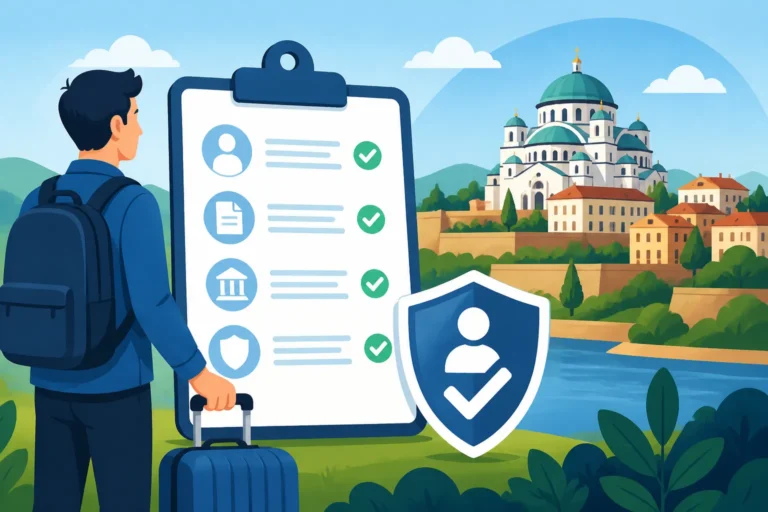
Here's a general checklist of documents you'll likely need, but always double-check the official MUP website or consult an expert, as requirements can change:
- Valid Passport: With at least six months validity beyond your intended stay.
- Visa D (Long-Stay Visa): If required for your nationality to enter Serbia. Most non-EU citizens need a Visa D if applying from outside Serbia.
- Completed Application Form: Usually filled out online.
- Proof of Accommodation: A notarized rental contract or a statement from your landlord (overen ugovor o zakupu or izjava stanodavca). This is absolutely critical.
- Proof of Funds: Bank statements showing sufficient means of support (e.g., a Serbian bank account balance or international bank statements). The exact amount is not always fixed but typically ranges from €100-€200 per month for the duration of the permit.
- Health Insurance: Proof of comprehensive health insurance coverage for the duration of your stay. This is non-negotiable. Many expats opt for international providers like Cigna Global, especially for the flexibility and comprehensive coverage they offer, bridging any gaps before you fully integrate into the local system. For more on this, see Health Insurance in Serbia: RFZO, Private and International Options Explained.
- Employment Contract or Business Registration Documents:
- For employees: An original employment contract, a letter of intent, or other proof of employment from a Serbian entity.
- For self-employed: Your registration certificate from the Business Registers Agency (APR) for your preduzetnik or DOO, and potentially a brief description of your business activities.
- Education Certificates/Professional Qualifications: Especially if your job requires specific skills.
- Police Clearance Certificate: From your home country and any country where you've resided for more than six months in the last five years. These often need to be legalized with an apostille.
- Photographs: Passport-sized photos, usually 3.5 x 4.5 cm.
- Proof of Paid Administrative Fees: There will be a series of fees (for the application, the permit card, etc.). These are typically paid at a post office or bank.
Crucial Advice on Translations and Legalizations:
Many documents, especially those from outside Serbia, will need to be translated into Serbian by a sworn court interpreter (sudski tumač). Furthermore, documents like your police clearance certificate often require an apostille stamp from the issuing country to be recognized as legal in Serbia. This process can be confusing, but our guide on Understanding Document and Translation Requirements for Serbia Immigration and How to Get Your Documents Apostilled for Serbia Immigration can help clarify things.
Here’s a quick overview of essential documents:
| Document Category | Specific Item | Requirement/Notes |
|---|---|---|
| Identity & Travel | Valid Passport | At least 6 months validity beyond intended stay. |
| Visa D (if applicable) | For non-visa-exempt nationals, obtained from Serbian embassy/consulate abroad. | |
| Residence Proof | Notarized Rental Contract / Landlord Statement | Proof of accommodation in Serbia. |
| Financial Solvency | Bank Statements | Proof of sufficient funds (e.g., €100-€200/month for duration of permit). |
| Healthcare | Health Insurance Policy | Comprehensive coverage for entire stay. |
| Work/Business Proof | Employment Contract | For employees, signed by a Serbian entity. |
| Business Registration (APR) | For self-employed/entrepreneurs. | |
| Background Check | Police Clearance Certificate | From home country & any country of residence >6 months in last 5 years; apostilled. |
| Personal Information | Application Form | Completed online via e-services portal. |
| Passport Photos | Standard 3.5 x 4.5 cm. | |
| Administrative Fees | Proof of Payment | Receipts for various government fees. |
| Translations/Legalizations | Certified Translations / Apostilles | For all foreign-issued documents, into Serbian by a sworn translator. |
The Online Application Portal: Your Digital Gateway
The Serbian government has largely moved the Single Permit application process online through the unified e-services portal. This portal aims to simplify submissions and track your application status. You’ll typically create an account, fill out the electronic application form, and upload scanned copies of all your supporting documents.
Steps to navigate the online portal:
- Create an Account: You'll need to register on the designated government portal (often linked through the MUP or specific e-uprava sites). This usually requires an email and creating a password.
- Fill the Form: The online form will guide you through entering your personal details, information about your employer/business, and the grounds for your application. Be meticulously accurate.
- Upload Documents: This is where your perfectly translated and scanned documents come into play. Ensure all files are clear, legible, and meet any specified size or format requirements (e.g., PDF).
- Pay Fees: The system will prompt you for the administrative fees. While the application is online, some fees may still require a physical payment at a bank or post office, for which you'll upload the payment slip (uplatnica).
- Submit: Once everything is uploaded and the form is complete, you submit your application electronically. You should receive a confirmation or tracking number.
The Interview and Biometrics: A Face-to-Face Follow-Up
Even with an online application, there's usually a mandatory in-person step. After your online submission, you'll typically be invited to the local police department for foreigners (the MUP office that handles stranci) to provide your biometrics (fingerprints and a digital photograph) and potentially have a brief interview. This is also often the stage where they want to see your original documents, so bring everything you uploaded.
Tips for your MUP visit:
- Be Prepared: Bring all original documents, including those that were translated and apostilled.
- Dress Respectfully: This is a government office, so present yourself professionally.
- Be Patient: Waiting times can vary significantly. Arrive early if possible.
- Language Barrier: While some MUP officers may speak English, it's not guaranteed. Consider bringing a Serbian-speaking friend or interpreter if you're not confident in your Serbian language skills.
- Stay Calm: The process can feel intimidating, but remain polite and cooperative.
The Waiting Game and Approval: The Long Haul
Once you've submitted everything and completed your biometrics, it's time for the waiting game. Processing times can fluctuate based on the volume of applications, the complexity of your case, and current administrative efficiency. While the Single Permit aims to be faster, it's still Serbia, and patience is a virtue. Historically, residence permit applications could take anywhere from a few weeks to a few months. The Single Permit is generally faster, often within 30-60 days, but always be prepared for potential delays. For more insights into typical timelines, check out How Long Does It Take to Get Residence in Serbia?.
If approved, you'll be notified, usually via the online portal or email. You'll then be instructed to pick up your physical Single Permit card, which will serve as both your residence and work permit. This card is your official ID for your stay in Serbia.
What Happens After Your Single Permit is Approved?
Congratulations, you've got your Single Permit! This is a huge milestone, but it's not quite the finish line. There are a few essential steps you'll need to take to fully integrate into Serbian life and ensure you remain compliant with local laws.
Receiving Your Residence Card: Your New Serbian ID
Your Single Permit comes in the form of a plastic ID card, similar to a local driving licence or national ID. This card is incredibly important – it's your official proof of legal residence and your right to work in Serbia. Always carry it with you, or at least a copy, and keep the original safe. This card is typically valid for one year and will need to be renewed before its expiry date if you wish to continue living and working in Serbia.
Registering Your Address (Prijava): A Legal Obligation
Within 24 hours of receiving your Single Permit (or arriving in Serbia, whichever is later), you are legally obliged to register your address with the police. This is known as prijava boravka. Even if you’ve already provided a rental contract for your Single Permit application, this is a separate and mandatory step. Usually, your landlord or host will do this with you at the local MUP office, but it's your responsibility to ensure it happens. If you fail to do so, you could face fines, or worse, issues with your permit renewal. This is a common pitfall for new expats, so prioritize it! Learn more about this crucial step in our guide, How to Register Your Address Prijava with the Police in Serbia.
Health and Social Security: Getting Covered
With your Single Permit, if you are employed by a Serbian company, your employer will automatically register you for mandatory social and health contributions with the Republic Health Insurance Fund (RFZO). This means you will have access to Serbia's public healthcare system. Understanding these contributions is important, and you can delve deeper into this topic with Understanding Mandatory Health Insurance Contributions in Serbia.
If you are self-employed, you will also be required to make these contributions as part of your pausal tax regime or regular tax filings. Even with public healthcare, many expats continue to hold private insurance, often through providers like Cigna Global, for access to private clinics, shorter wait times, and a wider range of English-speaking medical professionals. For a full breakdown of how the Serbian health system works, refer to How Serbia's Health System Works: The RFZO and Private Care Explained (2027).
Bringing Your Family: Reunification Process
Once you have successfully secured your Single Permit, you can then sponsor your immediate family members (spouse and minor children) to join you in Serbia. This process is called family reunification and involves a separate application for each family member. They will apply for their own temporary residence permits based on family reunification, using your Single Permit as the primary proof of support and legal residence. This is a common and important step for many expats, and our detailed guide Family and Dependent Residence in Serbia: Bringing Your Loved Ones will walk you through it.
Planning Your Move: Logistics and Settling In
With your permit sorted and your address registered, the practicalities of setting up your new life come into focus. Moving internationally involves a lot of logistics – from shipping your belongings to setting up utilities and finding your way around. Companies like Sirelo can be invaluable resources for comparing international moving services, helping you find reliable and affordable options to bring your life to Serbia. Beyond that, you'll want to think about banking, finding a community, and getting to know your new city. Our comprehensive guide, The Complete Guide to Moving to Serbia: Your First 90 Days (2027), offers a wealth of information to help you settle in smoothly.
Disclaimer
The information provided in this guide is for general informational purposes only and does not constitute legal or immigration advice. While we strive to keep the content up-to-date and accurate based on our experience and publicly available information, immigration laws and procedures in Serbia can change frequently. It is highly recommended that you consult with a qualified Serbian immigration lawyer or the official Ministry of Interior (MUP) website for the most current and specific advice pertaining to your individual circumstances before making any decisions related to your visa or residence permit application. We are not responsible for any actions taken based on the information presented here.