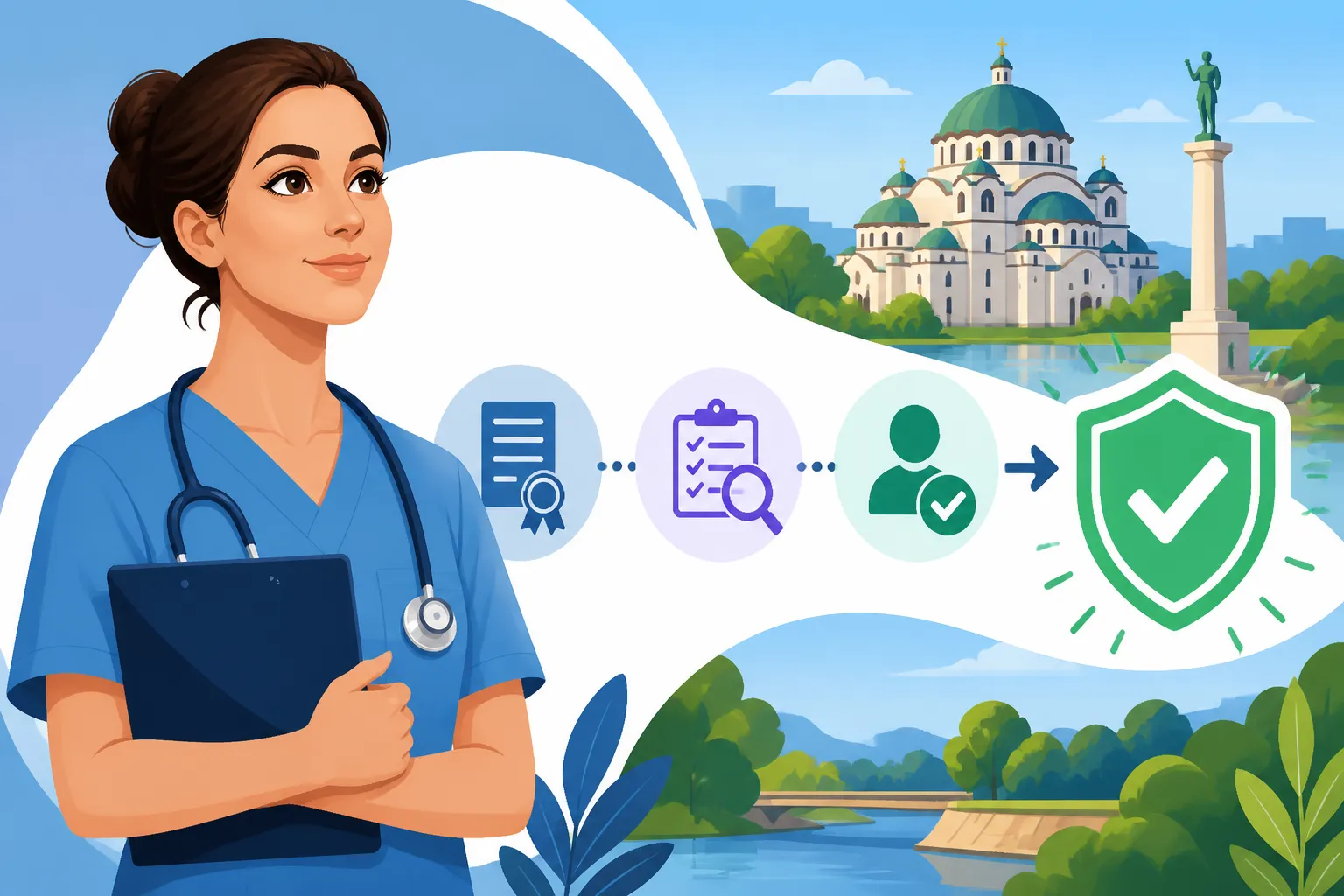
How Do I Get My Nursing Degree Recognised in Serbia?
Moving to a new country like Serbia with a professional qualification, especially one as vital as nursing, often brings a wave of excitement about a fresh start and new opportunities. However, that enthusiasm can quickly turn into a headache when you encounter the labyrinthine process of getting your hard-earned nursing degree officially recognized here. This guide is here to walk you through the often-frustrating, but ultimately navigable, journey of validating your nursing qualifications in Serbia, offering practical steps and a healthy dose of expat empathy.
The Initial Shock and Serbian Bureaucracy – Why Recognition Matters
Ah, the Serbian administrative machine. If you've spent any time here, you'll know it's a beast with many heads, and each one seems to demand a different stamp, signature, or obscure document. Coming from a country where your qualifications might be universally understood, the concept of having to prove their legitimacy again can feel like a personal affront. But trust me, this isn't personal; it's just Serbia. And for a profession as critical as nursing, ensuring proper qualification recognition, or "nostrifikacija" as it's known here, isn't just a bureaucratic hurdle – it's a non-negotiable step to protect patients and uphold professional standards.
Why Your Nursing Degree Needs "Nostrifikacija"
You might think, "I'm a fully qualified nurse in my home country, why can't I just start working?" The simple answer is, because Serbia says so. Every country has its own regulatory bodies, educational standards, and licensing requirements for medical professionals. Serbia is no different. The process of nostrifikacija ensures that your foreign education meets Serbian academic standards. It's essentially an equivalency check, confirming that the curriculum you studied, the hours you completed, and the skills you acquired are on par with what a Serbian-trained nurse would possess. Without this official recognition, your degree, no matter how prestigious it is internationally, holds no legal weight for professional practice in Serbia. It’s not about doubting your abilities; it’s about legal compliance and public safety within the Serbian healthcare system. Imagine the chaos if just anyone could walk in and declare themselves qualified without a local check – it simply wouldn't work. This is a fundamental step required for any foreigner looking to pursue a professional career here, as outlined in The Complete Guide to Working in Serbia as a Foreigner (2027).
The Emotional Toll of the Paper Chase
Let's be honest, dealing with bureaucracy in a foreign language is soul-crushing. There will be moments when you feel like you're playing a real-life version of "fetch" with a government office that keeps moving the goalposts. You'll gather a stack of documents, get them translated, notarized, apostilled, only to be told you're missing one tiny, seemingly insignificant piece of paper that was never mentioned before. This isn't unique to Serbia, but it's particularly acute here where the system can feel opaque and communication challenging. The sheer volume of paperwork, the multiple trips to various offices, the waiting times, and the potential for miscommunication can be incredibly frustrating. Many expats experience a similar "paper chase" when trying to get their foreign university degree recognised (Nostrifikacija) in Serbia, so you're definitely not alone. It's vital to prepare yourself mentally for a process that demands patience, persistence, and a healthy dose of humor. Don't let these moments define your experience; view them as rites of passage into Serbian life.
The Step-by-Step Gauntlet: Where to Start and What to Expect
Once you've braced yourself for the administrative marathon, it's time to get down to business. The recognition of foreign higher education documents in Serbia is handled by a specific body, and for professional qualifications like nursing, there are additional steps beyond just academic recognition. You're not just getting your diploma recognized; you're getting your right to practice recognized. This involves two main entities: the Agency for Qualifications (Agencija za Kvalifikacije, AKVS) for academic recognition and then the relevant professional chamber for licensing.
The Agency for Qualifications (AKVS) – Your First Stop
The first port of call for anyone seeking academic recognition of their foreign degree is typically the Agency for Qualifications (AKVS). They are the central body responsible for assessing the comparability of your foreign higher education with the Serbian system. Their job is to evaluate your degree, its curriculum, and its scope, to determine if it aligns with a recognized Serbian qualification.
Here’s a general overview of what to expect when dealing with AKVS:
- Application Submission: You'll need to submit an application form, which is usually available on their website. This form will detail all the information they require about your educational background.
- Document Compilation: This is where the real fun begins. You'll need to gather a comprehensive list of documents, including your original diploma, transcripts, a detailed syllabus or curriculum of your studies (describing all courses, practical hours, and exams), proof of previous employment (if applicable), and often a copy of your passport or ID.
- Translations and Notarization: Every single document that isn't already in Serbian will need to be officially translated by a sworn court interpreter (sudski tumač). After translation, these documents often need to be notarized. For documents originating from countries that are part of the Hague Apostille Convention, you’ll also need an Apostille stamp. If your country is not part of this convention, then the process involves superlegalisation through the Serbian Ministry of Foreign Affairs and your country's diplomatic representation. This is a critical and often time-consuming part of the process, so budget ample time and funds for it.
- Fee Payment: There will be an administrative fee for the recognition process. Make sure to pay it correctly, as proof of payment is a mandatory document.
- Submission: You typically submit everything in person at their office, or in some cases, via registered mail. Keep copies of everything!
It's absolutely crucial to check the most current requirements on the AKVS website, as these can change. Don't rely on old information from forums or even from well-meaning friends. The rules are constantly evolving, and a fresh check can save you a world of pain.
Document Gathering: The Dreaded "Papiri" List
Let's break down that 'dreaded list' of documents a bit further, because this is where many expats get tripped up. It’s not just about collecting papers; it’s about collecting the right papers, in the right format.
Key Documents You'll Likely Need:
- Original Diploma/Certificate: The one from your nursing school.
- Academic Transcripts: Detailed breakdown of all courses, grades, credits, and hours for each academic year.
- Curriculum/Syllabus: This is often the most challenging. You need a detailed description of the content of your nursing program, including theoretical and practical components, clinical placements, and learning outcomes. Sometimes your university can provide this as a course catalog or official syllabus. If not, you might have to compile it yourself, backed by official university descriptions. The more detailed, the better.
- Proof of Clinical Practice Hours: Certification from your university or hospitals where you did your clinicals, specifying the number of hours and areas of practice. This is vital for nursing.
- Proof of Professional Registration/License (from home country): If you were already licensed to practice in your home country, provide proof of this, including good standing certificates.
- Official ID/Passport: Copy, often notarized.
- Proof of Name Change (if applicable): Marriage certificate, deed poll, etc., also translated and notarized.
- Application Form: Filled out completely and accurately.
- Proof of Paid Fees: Bank receipt.
A Word on Translations and Apostilles:
- Sworn Court Interpreters: You cannot just use any translator. You must use a "sudski tumač" appointed by the Ministry of Justice of Serbia. A quick web search will give you a list, especially in Belgrade or Novi Sad. Expect these services to add significantly to your overall cost.
- Apostille: This is an international certification stamp. If your home country is a signatory to the 1961 Hague Convention Abolishing the Requirement of Legalisation for Foreign Public Documents, your original documents (diploma, transcripts) will need an Apostille from the competent authority in your home country before you translate them in Serbia. This verifies the authenticity of the original document. If your country is not a signatory, it’s a more complex process called ‘superlegalisation’ which involves multiple stamps from your country’s Ministry of Foreign Affairs and the Serbian embassy/consulate there.
This table gives you a simplified overview, but always double-check with AKVS directly for the most up-to-date, specific requirements.
| Document Type | Requirement | Notes |
|---|---|---|
| Original Diploma/Certificate | Apostille (if applicable), then official Serbian translation & notarization | Must be the original document. Apostille confirms authenticity in originating country. |
| Academic Transcripts | Apostille (if applicable), then official Serbian translation & notarization | Detailed breakdown of courses, grades, credits, and hours. |
| Curriculum/Syllabus | Official Serbian translation & notarization | Very detailed description of all studied subjects, practical work, and clinical hours. Often the most scrutinised document. |
| Proof of Clinical Hours | Official Serbian translation & notarization | Official letters from institutions where clinical practice was undertaken, specifying hours and type of experience. |
| Professional License | Official Serbian translation & notarization | Proof of current or past license to practice in your home country, including any certificates of good standing. |
| Passport/ID | Notarized copy | Identity verification. |
| Application Form | Filled in Serbian | Available on the AKVS website. |
| Proof of Fee Payment | Original bank receipt | Ensure correct amount and reference number. |
The Application Process: Patience is a Virtue
Once you’ve painstakingly gathered and prepared all your documents, it’s time to submit them. This is usually done in person at the AKVS office in Belgrade, or sometimes in other major cities if they have satellite offices or designated points for submission. When you hand over your meticulously prepared file, you might feel a huge sense of relief – but don't uncork the rakija just yet.
The processing time for recognition applications can vary wildly, from a few weeks to several months, depending on the complexity of your case, the volume of applications, and sometimes, the alignment of the stars. It's not uncommon to wait three to six months, or even longer in some instances, for the initial assessment. During this period, avoid the urge to call them daily. A polite follow-up email after a reasonable period (say, 2-3 months) is acceptable, but constant nagging won't speed things up and might actually annoy the very people reviewing your file. This waiting period can be particularly trying if you’re eager to start working, so it’s something to factor into your relocation timeline if you're planning on moving to Serbia. While you're waiting, it might be a good time to brush up on your Serbian language skills using platforms like iTalki, as proficiency will be crucial once you start working.
What Happens After Application: Waiting, Supplementary Exams, and the Final Hurdle
The AKVS will review your application and documents to determine the equivalency of your nursing education. This assessment is crucial because it dictates your next steps. You'll typically receive an official decision letter, and it could go one of several ways.
Potential Outcomes: Direct Recognition or Supplementary Requirements
The ideal outcome, of course, is full and direct recognition of your degree. This means the AKVS has determined that your education is fully equivalent to a Serbian nursing degree, and you can proceed to the next stage of professional licensing. While this happens for some, especially those from countries with very similar educational systems, it's not always the case.
More commonly, particularly for medical and paramedical professions like nursing, you might receive a decision that requires supplementary examinations or additional practical training. This doesn't mean your degree is "bad" or invalid; it simply means there are specific differences between your home country's curriculum and Serbia's. For instance, you might not have covered certain Serbian health laws, specific local epidemiological challenges, or particular practical procedures that are standard here. These supplementary requirements are designed to bridge those gaps, ensuring you meet the local standards before you can officially practice. It’s part of understanding How Serbia's Health System Works: The RFZO and Private Care Explained (2026) at a practical level. The letter from AKVS will clearly state what these additional requirements are, usually specifying which subjects you need to take exams in, and at which Serbian university or medical school.
Passing Supplementary Exams: Bridging the Knowledge Gap
If supplementary exams are required, you’ll need to enroll as a "diff student" (student na razlici) at a relevant Serbian medical faculty or higher medical school (Visoka Medicinska Škola). This means you'll register to take specific courses or exams that were identified as gaps in your qualification. This often involves:
- Contacting the Designated Institution: Reach out to the university or school mentioned in your AKVS decision letter. They will guide you on the enrollment process for supplementary exams.
- Course Material and Study: You'll be provided with study materials or syllabi for the subjects you need to pass. Depending on the subject, this might involve self-study, attending lectures, or completing practical modules.
- Taking the Exams: You'll sit for exams, just like any other student. These exams will likely be in Serbian, so your language skills will be severely tested here. This highlights why learning Serbian, perhaps with the help of resources like iTalki, is not just a polite gesture but a professional necessity.
- Proof of Completion: Once you pass all required exams, the university will issue a certificate of completion, which you'll need for the final licensing step.
This stage can be challenging. Not only are you learning new material, but you’re doing so in a foreign academic environment and language. It requires significant dedication and often involves a financial cost for tuition and materials.
Registering with the Chamber of Nurses and Health Technicians
After your academic degree is recognized by AKVS (either directly or after passing supplementary exams), and you have all the necessary certificates, you're still not quite ready to put on your scrubs. The next crucial step is to register with the professional body that regulates nursing practice in Serbia: the Chamber of Nurses and Health Technicians of Serbia (Komora medicinskih sestara i zdravstvenih tehničara Srbije).
This is where you get your actual license to practice. The Chamber will require:
- Proof of AKVS Recognition: Your official AKVS decision letter.
- Academic Documents: Your original recognized diploma and transcripts.
- Identification: Passport/ID.
- Proof of Serbian Citizenship or Residence Permit: You'll need to demonstrate your legal right to live and work in Serbia. This means having a valid work and residence permit, which is part of the larger process of getting a Residence Permit for Work in Serbia.
- Professional Liability Insurance: Often a requirement for medical professionals.
- Application Form: Provided by the Chamber.
- Membership Fees: Annual or one-time fees for joining the Chamber.
Once the Chamber reviews your application and documents, and everything is in order, they will issue you a professional license, allowing you to legally practice nursing in Serbia. This is the moment you've been waiting for – the culmination of all that bureaucratic effort!
Navigating the Serbian Healthcare System as a Foreign Nurse
Getting your degree recognized and obtaining your license is a massive accomplishment, but it's just the first step in your professional journey as a nurse in Serbia. The next challenge is integrating into the Serbian healthcare system itself, which comes with its own set of cultural nuances and practical considerations.
Language Barriers and Cultural Nuances
Even if you’ve been diligently studying Serbian with resources like iTalki, working in a professional medical environment is a different beast entirely. Medical terminology, patient communication, and team discussions often require a high level of fluency and cultural understanding. Patients, especially older ones, might not speak English, and colleagues will primarily communicate in Serbian. This is why it's highly recommended to pursue serious language study.
Culturally, the healthcare system in Serbia, much like any other, has its unwritten rules and hierarchies. Be prepared for a learning curve regarding team dynamics, patient expectations, and the general approach to medical care. While the medical standards are generally high, the operational aspects can differ from what you're used to. For instance, understanding how specialist and hospital referrals work in Serbia, or the nuances of the public vs. private healthcare systems, will be crucial. Take your time to observe, ask questions (politely!), and adapt. The Serbian people are generally welcoming, and if you show willingness, your colleagues will likely be very supportive.
Finding Employment and Salary Expectations
With your recognized degree and professional license in hand, you can begin the job hunt. Serbia has both public and private healthcare sectors. Public hospitals and clinics (domovi zdravlja) are the backbone of the system and are often more bureaucratic but offer stable employment. Private clinics and hospitals, especially in larger cities like Belgrade and Novi Sad, might offer more competitive salaries and potentially more modern facilities, but positions can be harder to come by or require specific specializations. The Expat Guide to Finding a Job in Serbia (2027) can offer broader advice on job seeking strategies.
You can look for jobs on common Serbian job boards like Infostud.rs, Hellojobs.rs, and Poslovi.rs. Networking within the medical community, perhaps through professional groups or by directly contacting hospitals, can also be very effective.
Salary Expectations: It's important to set realistic expectations regarding salaries. While the cost of living in Serbia is generally lower than in many Western European countries, nursing salaries in the public sector might also be lower than what you're accustomed to. According to recent data, the average net salary for nurses in Serbia can vary significantly based on experience, specialization, and whether you work in the public or private sector, as well as the city. Nurses in larger private clinics or those with specialized skills might command higher wages. It's always a good idea to research current salary benchmarks for your specific nursing role in Serbia to avoid any surprises. Don’t forget to consider the implications for your overall financial planning, including Understanding Income Tax and the Flat 10% Rate in Serbia and potentially seeking advice from services like Taxes for Expats when planning your finances.
Working as a foreign nurse in Serbia is a challenging but ultimately rewarding path. The initial hurdles of recognition and licensing require immense perseverance, but once cleared, you'll be able to contribute your skills to a country that genuinely appreciates dedicated healthcare professionals.
Disclaimer
Please note that the information provided in this guide is for general informational purposes only and does not constitute legal or professional advice. Requirements and procedures for qualification recognition, visas, and employment in Serbia are subject to change. It is essential to consult the official websites of the Agency for Qualifications (AKVS), the Chamber of Nurses and Health Technicians of Serbia, the Ministry of Interior (MUP), and relevant Serbian embassies or consulates for the most current and accurate information pertaining to your specific situation. We strongly recommend seeking independent legal counsel or professional assistance for personalized advice.