Can My Children Get Residence in Serbia Through Me?
Moving to a new country is a huge undertaking, but doing it with children adds an entirely new layer of complexity, especially when it comes to navigating the labyrinthine immigration system. Many expat parents arriving in Serbia often wonder about the practicalities of their children’s legal status – specifically, "Can my children get residence in Serbia through me?" The short answer is yes, absolutely. This guide is here to walk you through the process of securing residence permits for your little (or not-so-little) ones, ensuring they can legally live and thrive alongside you in Serbia.
The Foundation: Understanding Family Reunification
When you're establishing yourself in Serbia, securing your own temporary residence permit – whether it's for work, study, or entrepreneurship – is usually the first hurdle. Once your status is sorted, the pathway for your children, and indeed your spouse, typically falls under the umbrella of "family reunification." This is the Serbian government's way of ensuring families can stay together, which is a massive relief for expat parents already dealing with so much.
However, it's not simply a matter of saying "these are my kids." There are specific requirements and documentation to prove the familial link, your financial stability, and their integration into Serbian society. It’s a process that demands patience and meticulous attention to detail, much like anything involving bureaucracy here. Forget trying to shortcut anything; the Ministry of Interior (MUP) officials are not keen on exceptions.
Who Qualifies for Family Reunification Residence?
Generally, the immediate family members of a foreign national who already holds a valid temporary residence permit in Serbia are eligible. This primarily includes:
- Spouses: Legally married partners.
- Minor Children: Children under the age of 18, including biological children, adopted children, and in some cases, stepchildren, as long as they are dependent on the primary applicant.
- Adult Dependent Children: In exceptional circumstances, adult children who are unable to support themselves due to severe health conditions or disabilities might be considered, though this is a much more complex and less common scenario.
The crucial point here is dependence. For minor children, this is usually presumed. For adult children, you'd need substantial proof of their inability to live independently. You, as the primary resident, are essentially sponsoring their stay, taking full legal and financial responsibility for them during their time in Serbia. This also extends to their health coverage in Serbia.
The "Primary Applicant" Status
Before you even think about applying for your children's residence, you must have your own temporary residence permit (privremeni boravak) in place and valid for a sufficient period. This is non-negotiable. If you're still in the process of securing your own, it's best to wait until that's finalised. The MUP won't even entertain a family reunification application if the "anchor" – you – isn't firmly in place.
Think of it this way: your residence permit is the key that unlocks the door for your family. Without it, you’re all stuck outside. This foundational step is often where many expats feel the first pangs of frustration, as securing your own status can take time. But trust me, getting yours sorted first makes the rest of the journey smoother. You can learn more about this in our guide on how to apply for temporary residence (privremeni boravak) in Serbia.
Navigating the Application Process for Your Children
Once your own residence is secure, you can begin the journey to get your children theirs. The process, while similar to your own, has specific nuances related to proving familial ties and ensuring their welfare. It's often handled at the same MUP department where you obtained your own permit, usually the Foreigners Department (Uprava za strance) in your city. In Belgrade, that's Bulevar Mihaila Pupina in Novi Beograd, which can be a lively place, to say the least!
Essential Documentation
This is where Serbia's love for paperwork truly shines. You will need a stack of documents, and critically, many of them will need to be officially translated into Serbian by a certified court translator and often apostilled in your home country. This step alone can be a source of significant delays and costs, so start gathering early. Our guide on understanding document and translation requirements for Serbia immigration has more details.
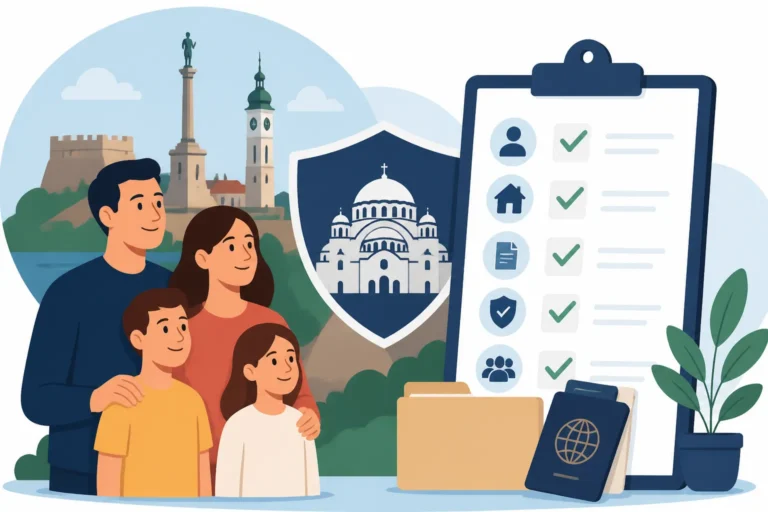
Here's a breakdown of the typical documents required for each child:
- Application Form (Zahtev za izdavanje privremenog boravka): This is the standard form, completed for each child.
- Valid Passport: The child's passport, with at least six months' validity beyond the intended period of stay. Copies of all stamped pages might also be required.
- Proof of Family Relationship: This is usually the most critical document.
- Original Birth Certificate (Izvod iz matične knjige rođenih): For each child, showing both parents' names. This must be apostilled in the country of issue and then officially translated into Serbian.
- Marriage Certificate (Venčani list): If applicable, to prove the relationship between you and your spouse, and thus, your joint parenthood. Also needs to be apostilled and translated.
- Your Valid Residence Permit: A copy of your Serbian temporary residence permit (boravak) and proof of its validity.
- Proof of Sufficient Funds: Documentation proving you have the financial means to support your children in Serbia. This can be bank statements, a letter from your employer stating your salary, or proof of a pension. The amount required is usually around minimum wage per month per person.
- Proof of Accommodation: A copy of your rental agreement or property ownership documents in Serbia. This needs to be notarized. If the child is with you, they're living at your registered address.
- Health Insurance: Proof of health insurance coverage for the duration of their stay. For children, this is vital. While you may have your own RFZO coverage, private insurance like that offered by Cigna Global is often a popular choice for expats, providing more comprehensive options and English-speaking services, which can be a real lifeline when dealing with children's health. You can also explore how to add dependents to your health coverage in Serbia through the RFZO.
- Two Passport-Sized Photos: Meeting Serbian standards (usually 3.5×4.5 cm, white background).
- Administrative Fees: Paid through a bank slip (uplatnica) at a post office or bank. The exact amount can vary, so always check the latest fees.
- White Card (Beli Karton): This is their address registration, just like yours. For children, this is usually tied to your registered address.
The Apostille Requirement – Don't Skip This!
I can't stress this enough: any official document issued outside of Serbia, like birth certificates or marriage certificates, will likely need an apostille. This international certification verifies the authenticity of the document's signature, seal, and stamp. Without it, the MUP simply won't accept your documents, and you'll be sent back to square one, which could mean sending documents back to your home country for processing. This is a common pitfall for new expats. Seriously, get this done before you even arrive in Serbia if you can! For more on this, check out how to get your documents apostilled for Serbia immigration.
Key Considerations and Potential Hurdles
Applying for your children's residence permit isn't always a straightforward "tick-box" exercise. There are a few things that can trip up even the most prepared expat parent.
Single Parent or Shared Custody Scenarios
If you are a single parent, or if you share custody with another parent who will not be living in Serbia, you will need additional documentation. This typically includes:
- Court Order or Custody Agreement: Official documents proving your sole custody or the other parent's agreement for the child to reside with you in Serbia. This document also needs to be apostilled and translated.
- Notarized Consent Letter: If the other parent has shared custody but is not moving to Serbia, a notarized consent letter from them, explicitly stating they agree for the child to live with you in Serbia and apply for residence, is usually required. This needs to be translated and potentially apostilled.
- Death Certificate: If the other parent is deceased, their death certificate (apostilled and translated) will be needed.
These situations demand even greater preparation and clarity in your documentation. The MUP wants to ensure the child's legal guardian(s) have all given their explicit permission for their relocation and residence in Serbia.
School Enrollment and Integration
While not always a strict requirement for the initial residence application, officials may inquire about your child's schooling plans. Having a plan, and ideally even pre-enrolling them, can demonstrate your commitment to their integration into Serbian life. Whether it’s a public Serbian school, an international school, or homeschooling, having a clear answer shows foresight.
This is also where considering logistical aspects, like how you'll move your family and their belongings, becomes crucial. Reputable moving services, like those found through Sirelo, can help alleviate some of the stress of international relocation, allowing you to focus on these important administrative tasks rather than the headache of shipping. They handle the heavy lifting (literally!) while you deal with the paperwork.
Financial Sufficiency and Support
The Serbian authorities need to be confident that your children will not become a burden on the state. This is why proof of funds is so important. Ensure your bank statements clearly show a consistent income or substantial savings. If you are self-employed, providing detailed financial records from your business may be necessary. The amount isn't exorbitant, but it needs to be reliably demonstrated. The general rule of thumb is showing you have enough for yourself plus a percentage for each dependent, usually based on the minimum wage.
Here's a simplified table outlining key documents and their preparation status:
| Document Type | Who Needs It? | Preparation (Crucial!) | Notes |
|---|---|---|---|
| Application Form | Each child | Fill in Serbian, accurately. | Available at MUP or online. |
| Passport | Each child | Valid for >6 months, copies of stamped pages. | Ensure no expired visas or issues. |
| Birth Certificate | Each child | Apostilled, then officially translated to Serbian. | Absolute must-do for non-Serbian documents. |
| Marriage Certificate | Parent(s) | Apostilled, then officially translated to Serbian. | If applicable, links parents to each other. |
| Parent's Residence Permit | Primary applicant | Copy of your valid Serbian boravak. | Foundation of the child's application. |
| Proof of Funds | Primary applicant | Bank statements, employment letter. | Show consistent income/savings to support family. |
| Proof of Accommodation | Family | Notarized rental contract or property title. | Must be a registered, legal address. |
| Health Insurance | Each child | Private policy or RFZO coverage. | Essential for access to healthcare. Cigna Global is an option. |
| Passport Photos | Each child | 2 photos, 3.5×4.5 cm, white background. | Specific dimensions and background are important. |
| White Card (Beli Karton) | Each child | Registration of address. | Usually done at local police station or MUP. |
| Administrative Fees | Primary applicant | Payment slips (uplatnica). | Check current fees at MUP or their website. |
| Parental Consent | If applicable | Notarized, apostilled, translated. | For single parents or shared custody situations. |
Maintaining and Renewing Your Child's Residence
Once your child’s temporary residence permit is granted, it will usually be valid for the same period as yours, often up to one year. This means that the renewal process will also coincide with yours, or at least be closely linked. This synchronization is usually a blessing, as it allows you to handle all family renewals at the same time.
The Renewal Process
Renewing your child's temporary residence permit is very similar to the initial application. You'll need to submit updated versions of most of the same documents:
- New Application Form: Always fill out a fresh one.
- Valid Passport: Check expiry dates!
- Updated Proof of Accommodation: Ensure your rental contract is still valid or provide a new one.
- Updated Proof of Funds: Show continued financial stability.
- Current Health Insurance: Proof of ongoing coverage.
- Previous Residence Card: The old boravak card.
- New Passport Photos:
- Administrative Fees:
The MUP will want to see that the conditions under which the initial residence was granted still apply. This includes your ongoing valid residence status, continued financial support, and continuous accommodation. Our guide on how to renew your temporary residence in Serbia offers more general advice that also applies to your children.
Transitioning to Permanent Residence
After a certain period of continuous temporary residence – usually three years for the primary applicant – you may become eligible to apply for permanent residence in Serbia. When you apply for yours, your children, if they have also maintained their temporary residence alongside you, can often apply for permanent residence concurrently or shortly after.
The criteria for permanent residence are more stringent, involving stricter checks on continuous stay, integration, and demonstrating a stable life in Serbia. However, the path for your children will largely depend on your success as the primary applicant. If you meet the criteria for permanent residence in Serbia, your minor children usually stand a very good chance of obtaining it too, provided they have been living with you throughout your temporary residence period.
For families planning a long-term future in Serbia, thinking about these longer-term immigration goals from the outset can save a lot of headaches down the line. It's not just about today, but about building a stable future for your family in your new home.
Practical Tips for Expats with Children
- Start Early: Immigration processes anywhere are slow. In Serbia, they can sometimes feel glacial. Give yourself ample time for document collection, apostilles, translations, and appointments.
- Be Patient and Polite: MUP officials are doing their job. A calm, respectful approach goes a long way, even if you feel frustrated.
- Get Organized: Keep all original documents and multiple copies. Create a binder for each child. This will be your lifeline.
- Consider a Local Legal Professional: Especially for complex cases (e.g., shared custody, adult dependents, specific nationalities), engaging a local immigration lawyer or consultant can be invaluable. They know the current requirements and unspoken rules.
- Stay Informed: Requirements can change. Always check the official MUP website or consult with your legal professional for the most up-to-date information.
- Network with Other Expat Parents: The expat community in Serbia is a fantastic resource. Other parents have been through this and can offer practical advice and emotional support.
Bringing your children to Serbia and securing their legal status is a significant step in establishing your family's new life here. While the paperwork might seem daunting, remember that countless families have successfully navigated this path. With meticulous preparation, patience, and a bit of local insight, your children will soon be enjoying everything Serbia has to offer alongside you. For general advice on settling in, be sure to check out the complete guide to moving to Serbia: your first 90 days (2027).
Disclaimer
The information provided in this article is intended for general guidance and informational purposes only and does not constitute legal advice. Immigration laws and regulations in Serbia are subject to change. It is highly recommended to consult with the official Serbian Ministry of Interior (MUP) or a qualified immigration lawyer in Serbia for the most current and accurate information pertaining to your specific situation.