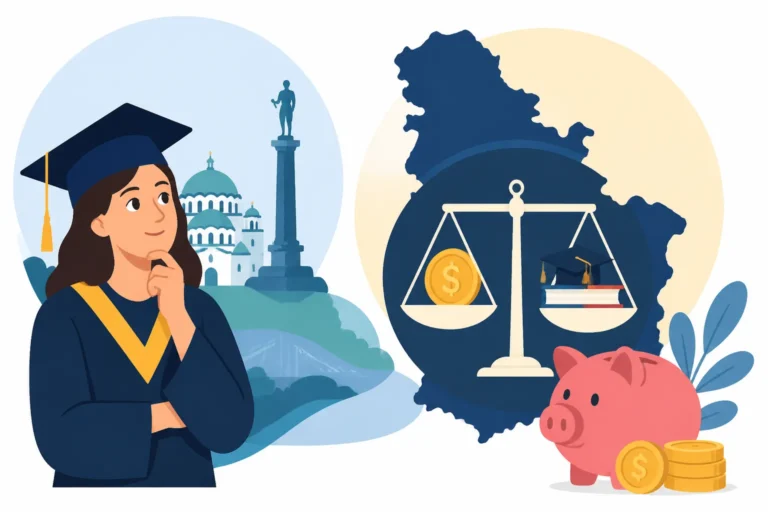
How Do I Get My Foreign Degree Recognised in Serbia?
Moving to a new country like Serbia often comes with the exciting prospect of a fresh start, whether for work or further education. However, many of us expats quickly hit a wall when we realise that our hard-earned degrees from back home aren't automatically recognised here. It's a frustrating, time-consuming hurdle, but a necessary one to truly integrate into the Serbian professional or academic landscape. This guide is here to walk you through the often-confusing process of getting your foreign degree recognised in Serbia, turning a complex administrative task into something manageable.
Understanding "Nostrifikacija": What It Really Means for Your Foreign Degree in Serbia
When you hear the term "nostrifikacija" in Serbia, it refers to the official recognition of foreign school certificates and higher education diplomas. It's more than just a translation; it's a formal process where your qualifications are assessed and equated to Serbian educational standards. This can feel like a bureaucratic headache, especially when you've already spent years studying, but it's a fundamental step for many expats.
Why Your Degree Needs Recognition in the First Place
The primary reason your foreign degree needs recognition in Serbia is purely legal and administrative. If you plan to work in a field that requires a specific level of education or a regulated profession, your employer will almost certainly demand a recognised diploma. Without it, you might find yourself limited to jobs where formal qualifications aren't strictly necessary, or worse, unable to secure the position you’re qualified for. Think about it: a Serbian company needs to ensure that your "Master of Science" from, say, a university in the UK, truly aligns with what their own universities award, and that you possess the equivalent knowledge and skills. It’s about standardisation and legal compliance.
Beyond employment, if you're looking to continue your education in Serbia, perhaps pursuing a master's or PhD, your previous degree must undergo nostrifikacija. Universities simply won't admit you to a higher program if your foundational degree isn't officially acknowledged within their system. This applies whether you're aiming for the University of Belgrade, the University of Novi Sad, or any other accredited institution. It’s all part of ensuring a consistent academic baseline across the board. For a deeper dive into continuing your education, you might find our guide on How to Apply to a Serbian University as an International Student helpful.
The Different Types of Recognition: Academic vs. Professional
It's crucial to understand that there isn't a single, monolithic "nostrifikacija" process. The path you take largely depends on what you intend to do with your degree. Generally, there are two main types: academic recognition and professional recognition.
Academic recognition is usually what people think of first. This is for those who need their degree formally equated to a Serbian academic qualification, either for further study or for general employment where the specific title is important but not necessarily regulated. For instance, if you have a Bachelor's in Marketing and want to work in a marketing agency, academic recognition would likely be sufficient. This process is typically handled by the ENIC/NARIC Centre within the Ministry of Education, Science and Technological Development, or directly by a university if you're applying for further studies there.
Professional recognition, on the other hand, is much more stringent and applies to regulated professions. These are jobs where specific qualifications and often licenses are legally required to practice. We're talking about doctors, dentists, lawyers, architects, pharmacists, and even some teaching positions. For these roles, simply having your degree academically recognised isn't enough. You'll need to go through an additional, often more complex, procedure with the relevant professional chamber or ministry. This path ensures that not only your academic credentials but also your practical experience and specific skill sets meet the rigorous Serbian standards for that profession.
The Step-by-Step Process for Academic Recognition (Nostrifikacija)
Navigating the academic recognition process can feel like a journey through a labyrinth of paperwork and waiting rooms. But armed with the right information, it becomes a series of manageable steps. Let's break down what you’ll need to do.
Gathering Your Documents: The Serbian Bureaucracy Checklist
The foundation of any successful application in Serbia lies in having meticulously prepared documents. This stage can be the most time-consuming and frustrating, so patience is your greatest ally. You’ll need a stack of originals and certified translations. Expect to provide your original diploma or certificate from your foreign institution, along with your full academic transcript detailing all courses taken, grades received, and the number of hours or ECTS credits for each. Don't forget the curriculum or syllabus for the program you completed. This document, often overlooked, is vital as it allows Serbian authorities to compare the content of your studies with their own educational standards.
Every single one of these documents, if not originally issued in Serbian, will need to be officially translated by a sworn court interpreter (sudski tumač) in Serbia. It’s not enough to get a translation done by just anyone; it has to be by an interpreter officially recognised by the Serbian Ministry of Justice. Once translated, many of these documents will also require an apostille or other form of super-legalization. An apostille is a certificate that authenticates the origin of a public document, and its requirement depends on whether your home country is a signatory to the Hague Apostille Convention. If not, a more complex "super-legalization" process involving multiple embassy or consular stamps might be necessary. This process is a common sticking point for many expats, so verifying the specific requirements for your country well in advance is crucial. You can find more general details about document requirements in our guide, Understanding Document and Translation Requirements for Serbia Immigration.
Submitting Your Application: Where to Go and What to Expect
Once your document arsenal is complete, it's time to submit your application. For academic recognition for general purposes or if you're not applying for further studies at a specific university, you'll typically submit your documents to the ENIC/NARIC Centre of Serbia, which operates under the Ministry of Education, Science and Technological Development. They have a dedicated department for this. You'll need to fill out their application form, which is usually available online or at their office. This form will ask for personal details, information about your foreign qualification, and the purpose of the recognition.
There will, of course, be a fee for the application process. The amount can vary, so it's always best to check the most current fee schedule on the ENIC/NARIC Centre's official website or by contacting them directly. You can usually pay this fee at a local post office or bank using a payment slip (uplata). After submission, expect a waiting period. The official timeline can vary, but generally, it takes several months. During this time, the Centre will review your documents, compare your curriculum to Serbian equivalents, and verify the authenticity of your degree with your foreign institution. It's not uncommon for them to request additional information or documents, so be prepared to respond promptly. While you wait, you might be thinking about other administrative tasks, and it's good to be aware of your financial obligations in Serbia. Our guide, Understanding Income Tax and the Flat 10% Rate in Serbia, might give you some insight into what comes next once your degree is recognised and you start earning.
The Evaluation Process and Potential "Difference Exams"
The heart of the nostrifikacija process lies in the evaluation. Experts at the ENIC/NARIC Centre or the university will meticulously compare your foreign educational program with comparable programs in Serbia. They look at everything: the duration of study, the subjects covered, the curriculum, the number of ECTS points, and the learning outcomes. Their goal is to determine if your degree is substantially equivalent to a Serbian one. If there are no significant differences, you'll likely receive a decision confirming the recognition of your degree.
However, it's not always a straightforward match. Sometimes, the evaluators might identify "programmatic differences" – subjects or modules that are mandatory in a Serbian equivalent degree but were not part of your foreign curriculum. In such cases, they may require you to pass "difference exams" (dopunski ispiti) at a Serbian university. This can be a significant hurdle, as it means enrolling in specific courses, attending lectures, and taking exams, often in Serbian. For instance, an engineering degree from abroad might be deemed lacking in a specific Serbian legal or regulatory aspect of engineering, leading to a requirement for an exam on that particular topic. Preparing for these can be tough, especially if your Serbian isn't fluent, but resources like private tutors or language learning platforms like iTalki can be incredibly helpful for brushing up on the language skills needed to tackle academic content. This is where the rubber meets the road, and a lot of expats can feel discouraged, but it’s a standard part of bridging any curriculum gaps.
Professional Recognition: A Different Path for Regulated Professions
If your career path falls into the category of regulated professions, your journey to degree recognition will diverge from the standard academic path. This is a more complex and often lengthier process, designed to ensure public safety and maintain professional standards.
Identifying Regulated Professions in Serbia
Regulated professions are those where the practice of the profession is legally restricted to individuals who possess specific qualifications and often, a license issued by a designated professional body or state authority. In Serbia, just like in many other countries, this typically includes fields like medicine (doctors, nurses, dentists, pharmacists), law (lawyers, judges, notaries), architecture, engineering, and teaching. For example, a doctor trained in Germany cannot simply start practicing in a Serbian hospital after getting academic recognition of their medical degree. They need their medical qualification to be professionally recognised by the relevant medical chamber. This is crucial because these professions have direct impacts on public health, safety, and legal frameworks, requiring a higher level of scrutiny beyond just academic equivalency.
It's vital for expats considering these fields to accurately identify if their profession is regulated in Serbia. The best way to do this is to check with the Ministry of Health, Ministry of Justice, Ministry of Education, Science and Technological Development, or the specific professional chamber in question. Each body will have its own guidelines and requirements. For instance, aspiring teachers might need to contact the Ministry of Education for specific teaching certificate recognition, which often goes beyond a simple university degree nostrifikacija. Understanding the Rules for Foreign Workers in Serbia is also a good preliminary step, as it outlines general employment regulations that intersect with professional qualifications.
The Role of Professional Chambers and Ministries
Unlike academic recognition which often centralises at the ENIC/NARIC Centre or individual universities, professional recognition is decentralised and handled by the specific professional chambers or ministries relevant to your field. These bodies are responsible for setting and maintaining professional standards, issuing licenses, and overseeing the practice of their respective professions. For instance, the Medical Chamber of Serbia (Lekarska komora Srbije) is the authority for medical doctors, while the Serbian Bar Association (Advokatska komora Srbije) handles legal professions. Each chamber will have a specific process tailored to the unique requirements of that profession.
Their application procedures often go beyond just evaluating your academic transcript. They might require proof of extensive practical experience, internships, or residency programs completed in your home country. In many cases, you might be asked to sit for additional professional examinations, sometimes encompassing local laws, regulations, or specific medical practices unique to Serbia. For example, a foreign lawyer might need to pass an exam on Serbian civil law and legal procedures to be allowed to practice. This ensures that you are not only academically qualified but also competent to operate within the Serbian professional context. These processes can be quite demanding and require a deep understanding of the local professional landscape, often necessitating legal or expert assistance to navigate successfully.
Costs, Timelines, and Common Pitfalls to Avoid
Going through the degree recognition process in Serbia is a commitment, both in terms of time and money. Being prepared for these aspects can help alleviate some of the stress and potential setbacks.
Financial Outlays: What to Budget For
The costs associated with getting your foreign degree recognised in Serbia can accumulate, so it's wise to budget carefully. The primary expenses will include the application fees charged by the ENIC/NARIC Centre or the relevant professional chamber. These fees are statutory and non-negotiable, typically ranging from a few thousand to several tens of thousands of Serbian Dinars, depending on the complexity and type of recognition. Beyond that, certified translations by a sworn court interpreter are a significant cost. You can expect to pay per page or per word, and if your academic transcript or curriculum is lengthy, this can quickly add up. A typical university transcript could easily cost €100-€200 to translate.
Then there are the notarization fees for certifying copies of your original documents, and if required, the costs for obtaining an apostille or undertaking the super-legalization process. These government fees can vary. If you’re asked to sit for difference exams, you'll incur additional university fees for enrolment in those courses and taking the exams. Lastly, don't forget potential costs for professional assistance, such as a lawyer specializing in administrative law or an education consultant, which many expats find invaluable. These services, while an added expense, can save you time and frustration by ensuring your application is flawless. Considering these various financial aspects is important, and understanding the broader financial context of moving here can also be helpful, especially when looking at the overall picture of your finances. Many expats find resources like Taxes for Expats helpful for managing their global tax situation, ensuring they’re prepared for all financial implications of living and working abroad.
Managing Expectations: Realistic Timelines
One of the most challenging aspects of Serbian bureaucracy, and indeed bureaucracy anywhere, is the waiting game. While official timelines might state a few months for academic recognition, realistically, it can often take longer. For academic recognition through the ENIC/NARIC Centre, you should anticipate anything from three to six months, sometimes even longer if there are queries or if your institution is slow to respond to verification requests. If you're applying for recognition directly through a university for further studies, their internal processes might be slightly different, but still anticipate a significant wait.
For professional recognition, the timelines are generally much longer and less predictable. Because these processes involve professional chambers and often require more in-depth evaluations, potentially including practical assessments or mandatory internships, it could easily stretch from six months to over a year, or even longer in some complex cases. It's crucial to factor these extended timelines into your relocation plans. Don't expect to arrive in Serbia and start practicing a regulated profession immediately. It’s a marathon, not a sprint. Regularly following up, politely, of course, can sometimes help, but primarily, it's about persistent patience. For those who are also thinking about their long-term stay, understanding How to Get Temporary Residence (Boravak) in Serbia (2027) is also key, as your degree recognition might tie into your overall immigration status.
Navigating the Hurdles: Tips from a Fellow Expat
Having been through my share of Serbian administrative hurdles, I can tell you that successful navigation largely comes down to a few key principles. First and foremost: patience and persistence. Things here rarely happen at lightning speed, and you might need to visit offices multiple times or make numerous phone calls. Don't get discouraged; it's part of the process. Always be polite, even when you're feeling frustrated, as a positive attitude often yields better results.
Secondly, gather all your documents, and then some, before you even start the process. This means obtaining original diplomas, transcripts, and detailed curricula well in advance. Get them apostilled or super-legalised in your home country if possible, as it's often easier than doing it from Serbia. Having everything neatly organised and readily available will save you immense stress. Thirdly, consider professional help. While it's an added cost, a local lawyer or consultant specializing in administrative procedures can be invaluable. They know the system, the specific requirements, and often have direct contacts, which can expedite matters or at least ensure no critical steps are missed. Finally, while not strictly necessary for the application itself, learning Serbian is incredibly helpful. Even basic conversational skills can make your interactions with officials smoother and reduce misunderstandings. Platforms like iTalki offer affordable one-on-one lessons with native speakers, which can be a game-changer for navigating daily life and administrative tasks.
Here's a quick comparison of the two main recognition paths:
| Feature | Academic Recognition (Nostrifikacija) | Professional Recognition |
|---|---|---|
| Purpose | General employment, further academic study, proving academic equivalency | Legal permission to practice a regulated profession (e.g., doctor, lawyer) |
| Primary Authority | ENIC/NARIC Centre, individual universities | Specific professional chambers, relevant ministries |
| Key Documents | Diploma, transcript, curriculum, sworn translations, apostille/legalization | All academic documents, proof of experience, internships, licenses, sworn translations, apostille/legalization |
| Evaluation Focus | Academic content, study duration, ECTS comparison | Academic content, practical skills, local legal/professional standards, ethics |
| Potential Additional Steps | "Difference exams" at a university | Specific professional exams, supervised practice, internships |
| Typical Timeline | 3-6 months (can be longer) | 6-18 months (often highly variable and complex) |
| Complexity | Moderate | High |
| Costs | Application fees, translation, notarization, apostille, exam fees | Application fees, translation, notarization, apostille, professional exam fees, potential training/internship costs |
Getting your foreign degree recognised in Serbia is definitely a process that requires effort, but it's an essential one for many expats to fully integrate into their chosen careers or academic pursuits. With careful planning and a good dose of patience, you'll get there. For a more general overview of working in the country, you might want to read The Complete Guide to Working in Serbia as a Foreigner (2027).
Disclaimer
The information provided in this guide is for general informational purposes only and does not constitute legal or professional advice. While we strive to keep the information accurate and up-to-date, administrative procedures in Serbia can change frequently. It is highly recommended to consult with the official authorities (Ministry of Education, ENIC/NARIC Centre, relevant professional chambers, or legal counsel) for the most current and specific requirements pertaining to your individual situation.