Can I Deduct Business Expenses on My Serbian Tax Return?
One of the trickiest parts of setting up any kind of business in Serbia, especially as an expat, is figuring out what you can and can't deduct when it comes to taxes. It's not always straightforward, and the rules can be a maze, often leading to a lot of head-scratching and worry about making a misstep with the Poreska Uprava, Serbia's tax administration. This comprehensive guide is here to untangle the complexities of deducting business expenses on your Serbian tax return, giving you the clarity and confidence to manage your finances like a local.
Understanding Business Expenses in Serbia: The Basics for Expats
When you first arrive in Serbia and start exploring options for working or running a business, you'll quickly encounter the different ways you can be structured. This choice fundamentally impacts whether and how you can deduct business expenses. It's a key distinction that often catches newcomers off guard.
Who Can Deduct Expenses? Differentiating Legal Structures
The ability to deduct business expenses in Serbia heavily depends on your legal structure. It's not a one-size-fits-all scenario, and confusing the options can lead to unexpected tax liabilities.
Many self-employed individuals and freelancers in Serbia gravitate towards the Pausal regime, a simplified lump-sum taxation system. If you choose this path, congratulations, you get a fixed, predetermined tax amount each month, calculated based on your activity, municipality, and a few other factors. The fantastic benefit here is that you absolutely do not track or deduct actual business expenses. Your fixed tax covers everything, offering immense administrative simplicity. For many, this simplicity is precisely why they choose this route. You don't need to keep a meticulous record of every pencil or coffee cup that might relate to your business, because those actual costs simply aren't factored into your tax. This means the question "Can I deduct business expenses?" becomes moot if you're a pausalac, as your deductions are built into your lump-sum tax. You can learn more about this popular option in our guide, Understanding the Pausal Lump-Sum Tax Regime in Serbia 2026.
However, if you're an entrepreneur (preduzetnik) who has opted for actual cost accounting (umesto paušalno oporezivanje) or if you've registered a company (društvo sa ograničenom odgovornošću or DOO), then yes, the world of business expense deductions is very much open to you. This is where the meticulous record-keeping and understanding of Serbian tax law truly come into play. For these structures, every dinar spent for business purposes potentially impacts your taxable profit.
General Principles of Deductibility: What Qualifies?
For those operating under the actual cost system or as a DOO, the general principle for deductibility in Serbia isn't too different from many other countries: an expense must be incurred solely for the purpose of generating taxable income for your business. This is often referred to as the "business purpose" rule. If an expense has a dual purpose – part personal, part business – it typically needs to be clearly segregated, or only the business portion can be deducted, often under very specific conditions.
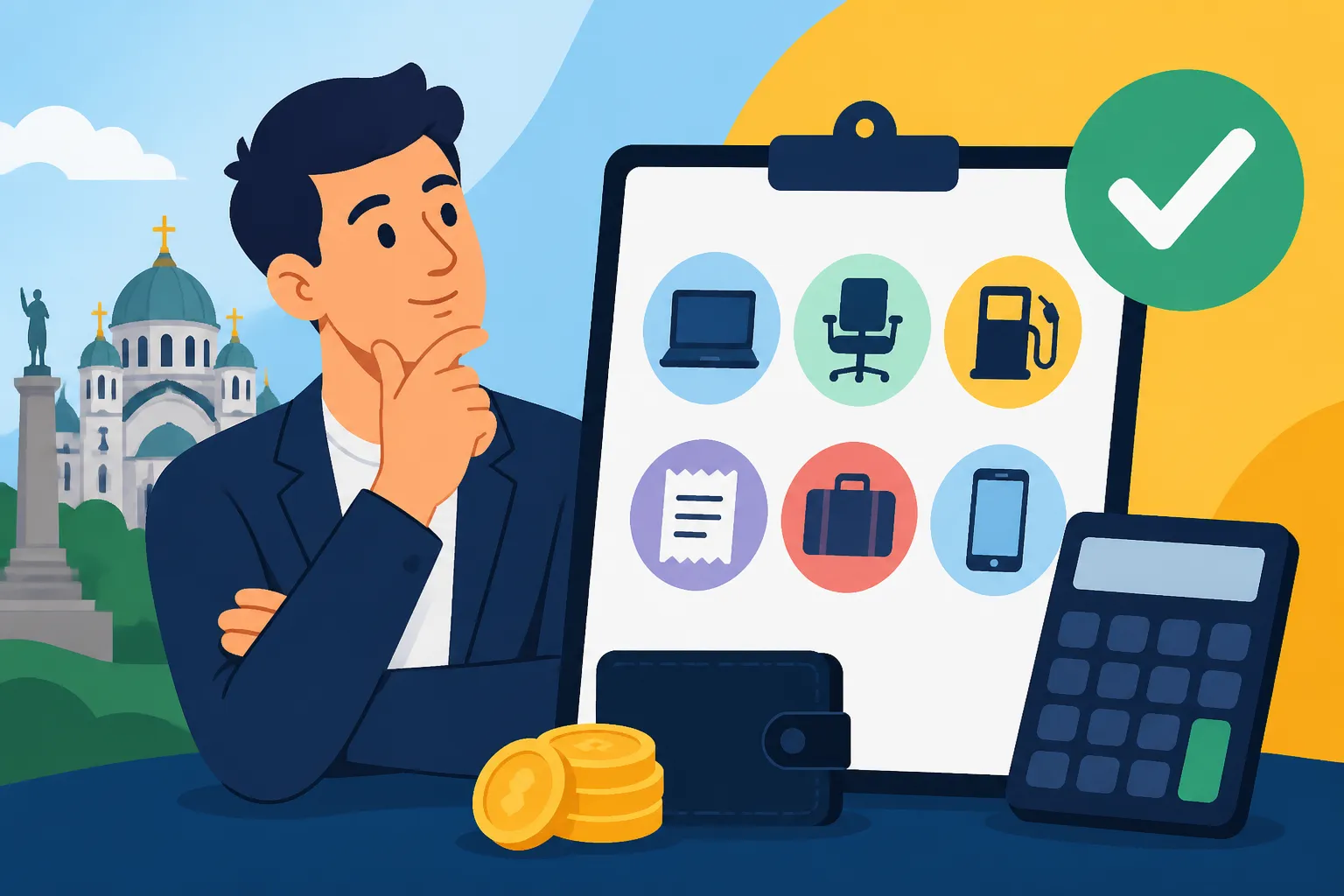
Common types of expenses that generally qualify include:
- Operational Costs: Things like office rent, utility bills for a dedicated business space, internet, and phone services directly tied to your operations.
- Supplies and Equipment: Stationery, computer equipment, software licenses, or specific tools needed for your work.
- Professional Fees: Payments to accountants, lawyers, consultants, or other professionals whose services are necessary for your business. This is where firms like Taxes for Expats can become an invaluable resource, helping you navigate the system and ensuring your accounting is up to snuff.
- Marketing and Advertising: Costs associated with promoting your business, building a website, or engaging in public relations.
- Travel and Accommodation: If you need to travel for business purposes, the costs of flights, trains, and lodging can often be deducted, provided there's clear documentation of the business nature of the trip.
The key takeaway here is robust documentation. The Serbian tax authorities, the Poreska Uprava, expect to see valid invoices (računi) or fiscal receipts (fiskalni računi) that clearly state the nature of the expense and the recipient's tax identification number (PIB) if applicable. Without proper paperwork, even a legitimate business expense could be disallowed.
Common Deductible Expenses for Entrepreneurs and Companies in Serbia
Let's dive deeper into the specific categories of expenses that typically get the green light for deduction, assuming you are not on the Pausal regime and are diligently tracking your actual costs. This is where the rubber meets the road for companies and those entrepreneurs who have chosen a more complex, but potentially more flexible, tax path.
Operational Costs: Keeping Your Business Running
These are the bread and butter expenses that keep your business lights on, literally and figuratively. They are usually straightforward, but the devil, as always, is in the details of documentation.
If you're running a design studio, a consulting firm, or even a small agency, you’ll have recurring expenses to consider. For example, your office rent is almost certainly deductible. Whether you rent a dedicated office space in Belgrade's New Belgrade business district or a smaller co-working desk in Novi Sad, the monthly rent, along with any associated maintenance fees, can be claimed. Crucially, your rental agreement must be formal and ideally registered, and you need proper invoices from your landlord. Similarly, the utility bills for that office space – electricity (EPS), heating, water, and waste removal – are also typically deductible.
Then there's your digital lifeline: internet and phone services. In today's interconnected world, these are indispensable. The monthly subscription fees for your business internet, any dedicated business phone lines, or even a portion of your mobile phone bill if it's primarily used for work, can usually be deducted. Again, keep those monthly invoices from providers like Telekom Srbija or A1. The challenge for expats often lies in ensuring the invoice is in the business's name or your entrepreneur's PIB, not your personal name. If it's in your personal name, justifying the business portion can be a headache unless it's a home office scenario with clear proportional use.
Professional Services and Education
Investing in expertise and knowledge is often vital for business growth, and thankfully, many related costs can be offset against your income.
Top of the list are accounting fees. Trust me, navigating Serbian tax law without a local accountant is like trying to cross the Danube blindfolded. These fees, paid to your chosen accounting firm, are fully deductible as they are directly necessary for your business's legal and financial compliance. Similarly, legal advice, whether for drafting contracts, resolving disputes, or understanding local regulations, is a legitimate business expense. Any fees paid to lawyers fall into this category.
For many expats, continuous learning and development are key. If you invest in professional development courses, seminars, or certifications directly relevant to your business activity – say, a new coding language course for a software developer, or a marketing strategy workshop for a consultant – these expenses can often be deducted. The key is demonstrating their direct relevance to generating your business income. Generic personal development courses, however beneficial, likely won't pass the test. Even software subscriptions, whether for graphic design tools, project management platforms, or CRM systems, are legitimate deductions, as long as they are integral to your operations.
Marketing, Travel, and Representation Costs
Getting your name out there and meeting clients are crucial for many businesses, but these categories often come with stricter rules.
Marketing and advertising expenses are generally fully deductible. This includes costs for website development and hosting, digital ad campaigns on platforms like Google or Facebook, print ads, and even expenses for creating promotional materials like brochures or business cards. If you're building a brand, these investments are clearly for business gain.
Business travel expenses are another area of common deductions. If your work requires you to travel to, say, Novi Sad for a client meeting, or internationally for a conference, the costs of your transportation (plane tickets, train fares, fuel for a company car) and accommodation (hotel stays) are typically deductible. However, you need to prove the business nature of the trip. A conference agenda, meeting minutes, or emails confirming appointments are invaluable. Personal sightseeing woven into a business trip would, understandably, not be deductible.
Representation costs, such as entertaining clients or business partners, are a bit more nuanced. In Serbia, these are generally partially deductible, often up to a certain percentage (e.g., 30%) for corporate income tax purposes, and require strict documentation. For instance, taking a client out for dinner in Skadarlija, Belgrade, might be partially deductible, but only with a fiscal receipt and a clear record of the business purpose and attendees. Lavish personal celebrations certainly won't make the cut.
Here's a quick overview of how different entrepreneur types handle expenses:
| Feature | Pausal Entrepreneur (Lump-Sum Tax) | Actual Cost Entrepreneur (DOO also applies) |
|---|---|---|
| Expense Deduction | No actual expenses are deducted. | All legitimate business expenses are deductible. |
| Record Keeping | Minimal, typically just income register. | Meticulous records, invoices, receipts required. |
| Tax Calculation | Fixed monthly lump sum, regardless of actual expenses. | Based on actual profit (Income – Expenses). |
| Administrative Burden | Very low. | Higher, requires an accountant for proper tracking. |
| Flexibility | High, if actual expenses are low. | Higher, if actual expenses are high; can claim losses. |
| Ideal For | Freelancers, small service providers with low fixed costs. | Businesses with significant variable/fixed costs, higher revenues. |
Non-Deductible Expenses and Important Considerations
Just as important as knowing what you can deduct is understanding what you cannot. Many expats, especially those used to different tax systems, can inadvertently blur the lines between personal and business expenditures, leading to potential issues with the Serbian tax authorities.
Personal Expenses vs. Business Expenses: A Clear Line
This is perhaps the most common trap for new entrepreneurs in any country, and Serbia is no exception. The tax system here is quite strict about separating your personal wallet from your business one. Your daily groceries, your personal apartment rent (unless a portion is clearly designated and used exclusively as a home office), your personal transportation costs (unless directly related to business travel), or even that new designer jacket you bought (unless it's a specific uniform for your business and only worn for work purposes) are all not deductible.
The line must be clear and distinct. For example, if you work from home, a portion of your utility bills might be deductible, but only the part directly attributable to your home office space. You can't deduct your entire electricity bill just because you check work emails from your living room sofa. This often means calculating a percentage of your home's square footage used for business and applying that percentage to relevant bills. It's an area where the Poreska Uprava will scrutinise carefully, so precise calculations and justification are key. Mixing personal and business funds, especially if you're using a single bank account for both, is a recipe for disaster come tax time and makes it nearly impossible to differentiate. This is where having separate bank accounts, perhaps one for business facilitated by a service like Wise for international client payments and another for personal use, becomes incredibly helpful for clear financial separation.
Capital Expenditures and Depreciation
Not every large purchase for your business can be fully expensed in the year you buy it. This is a common point of confusion. When you purchase significant assets that will be used for more than one year – like a new powerful computer for your design work, office furniture, or a company vehicle – these are generally considered capital expenditures. Instead of deducting the full cost upfront, you depreciate these assets over their useful life.
Depreciation means you spread the cost of the asset over several years, deducting a portion each year. For instance, a new laptop might be depreciated over three years, meaning you deduct one-third of its cost each year. The Serbian tax law specifies depreciation rates for various asset categories. There are usually simplified rules or immediate expensing for "small value assets" (e.g., below a certain dinar threshold), but for larger investments, depreciation is the standard. Your accountant will be able to guide you on the specific rates and how to correctly apply them, ensuring you comply with local regulations.
The Importance of Proper Documentation and Serbian Accounting Standards
I cannot stress this enough: documentation is king. In Serbia, the Poreska Uprava will demand valid, properly issued documents for every single expense you claim. This means:
- Valid Invoices (Račun): For services or goods from another registered business, you need a proper invoice. This invoice must contain specific information, including the seller's and buyer's full details (name, address, PIB), the date of issue, a clear description of the goods or services, the quantity/unit price, total amount, and VAT details if applicable.
- Fiscal Receipts (Fiskalni Račun): For cash purchases from retail establishments, you'll need a fiscal receipt generated by a certified fiscal cash register. These typically include a QR code and specific identification numbers.
- Contracts: For ongoing services (like rent, accounting, or long-term consulting), a written contract outlining the terms and payments is often required in addition to monthly invoices.
- Bank Statements: While not proof of the nature of an expense, bank statements are crucial for proving that a payment was actually made. They will be cross-referenced with your invoices and receipts. If you're using a platform like Wise for business transactions, these statements will be particularly vital for tracing international payments and ensuring they align with your Serbian documentation.
Trying to deduct an expense with a handwritten note, a random email, or an invoice missing critical information will almost certainly lead to it being disallowed. Serbian accounting standards (generally based on International Financial Reporting Standards for larger entities, and simpler rules for smaller ones) are precise, and adherence is mandatory. Keeping your records organised, ideally digitally, will save you immense headaches during tax filing and in the event of an audit. This meticulous approach is part of Filing Your Tax Return with the Poreska Uprava in Serbia: The Complete Walkthrough (2027).
Navigating the Serbian Tax System for Deductions: Practical Advice
Alright, so you've grasped the theoretical side of deductions. Now, how do you actually make this work without losing your mind in the Serbian administrative jungle? For many expats, this is the most daunting part, but with a few smart strategies, it becomes much more manageable.
Working with an Accountant: Your Essential Ally
Let me be absolutely clear: if you are not a Pausal entrepreneur, or if you run a DOO, then hiring a competent, local accountant in Serbia is non-negotiable. Seriously. This isn't just a suggestion; it's a lifeline.
A good Serbian accountant fluent in both English and local tax law will:
- Classify Expenses Correctly: They know the nuances of what is and isn't deductible, and how to properly categorise expenses according to Serbian accounting standards. This is invaluable, as misclassification can lead to penalties.
- Ensure Proper Documentation: They will advise you on the exact type of invoice or receipt you need for various transactions and can even help you identify when documentation is insufficient.
- Prepare and File Tax Returns: They will compile all your expenses and income, calculate your tax liabilities, and ensure your annual tax return is submitted accurately and on time to the Poreska Uprava. This is particularly crucial for understanding your overall tax burden, including Understanding Mandatory Social and Health Contributions in Serbia.
- Communicate with Tax Authorities: In the event of queries or an audit, your accountant will act as your intermediary with the tax office, navigating the bureaucracy and technical language on your behalf.
- Stay Up-to-Date: Serbian tax laws can change. Your accountant stays on top of these changes, ensuring your business remains compliant.
Don't try to go it alone to save a few dinars. The potential cost of mistakes, fines, and wasted time due to non-compliance far outweighs the cost of professional accounting services. Many accounting firms in major cities like Belgrade or Novi Sad have experience with foreign clients and can communicate effectively in English, making the process smoother. They can even advise you on how your overall The Complete Guide to Taxes in Serbia for Expats (2027) will be affected.
Record Keeping Best Practices for Expats
Even with an accountant, you are responsible for providing them with accurate and timely information. Developing good record-keeping habits from day one will make your life significantly easier.
- Digitalisation is Your Friend: As soon as you receive a physical invoice or receipt, take a clear photo or scan it. Store these digital copies in an organised cloud folder (e.g., Google Drive, Dropbox) with logical subfolders (e.g., "2024_Expenses/January_Rent"). This way, if a physical receipt fades or gets lost, you have a backup.
- Monthly Reconciliation: Don't wait until the end of the quarter or year. Dedicate a few hours each month to go through your bank statements and match every transaction to a corresponding invoice or receipt. This helps catch missing documents early and keeps your financial picture clear.
- Understand Basic Serbian Tax Vocabulary: You don't need to be fluent, but knowing key terms like račun (invoice), fiskalni račun (fiscal receipt), PDV (VAT), PIB (Tax ID Number), and porez (tax) will help you identify the right documents and communicate effectively.
- Separate Finances: As mentioned, maintain completely separate bank accounts for your business and personal finances. This creates a clear audit trail and prevents any confusion. If you receive international payments from clients, a service like Wise can be excellent for managing multi-currency income, but ensure these transactions are clearly linked to your Serbian business entity and properly recorded by your accountant. Your bank statements from Wise would then form part of your financial records to be handed over to your accountant.
Tax Audits and Common Pitfalls
While nobody wants an audit, they are a reality of doing business. Being prepared significantly reduces stress. The Poreska Uprava can conduct audits to verify your financial records and tax compliance. They typically look for consistency between your declared income, expenses, and supporting documentation.
Common pitfalls for expats, which can trigger closer inspection, include:
- Lack of Proper Serbian Invoices: Relying on informal notes or non-compliant international invoices for Serbian-sourced expenses.
- Mixing Personal and Business Funds: This instantly raises red flags and complicates every transaction.
- Incorrect VAT Application: If you're VAT-registered (PDV obveznik), mistakes in charging or claiming VAT can lead to issues.
- Misclassification of Expenses: Attempting to deduct personal expenses disguised as business costs.
- Insufficient Proof of Business Purpose: For ambiguous expenses, lacking clear evidence that they were solely for generating taxable income.
To minimise risk, always consult your accountant for clarity, keep all original documentation (physical and digital), and ensure that every expense you claim has a legitimate business rationale and proper paperwork. Understanding How to Register with the Tax Administration Poreska Uprava in Serbia and How to File Your Annual Tax Return in Serbia are crucial steps in this process.
In conclusion, yes, you absolutely can deduct business expenses on your Serbian tax return, but it largely depends on your chosen legal structure and your commitment to meticulous record-keeping and local compliance. For many, the Pausal regime offers a stress-free alternative by eliminating the need for expense tracking altogether. For those with more complex business models or higher overheads, embracing the detailed world of actual cost accounting with the invaluable support of a local Serbian accountant is the path to tax efficiency and peace of mind.
Disclaimer
The information provided in this guide is for general informational purposes only and does not constitute professional tax, legal, or financial advice. Tax laws and regulations in Serbia can change frequently and vary depending on individual circumstances. It is essential to consult with a qualified Serbian tax advisor or accountant to obtain advice tailored to your specific situation before making any decisions. We are not liable for any actions taken based on the information presented herein.