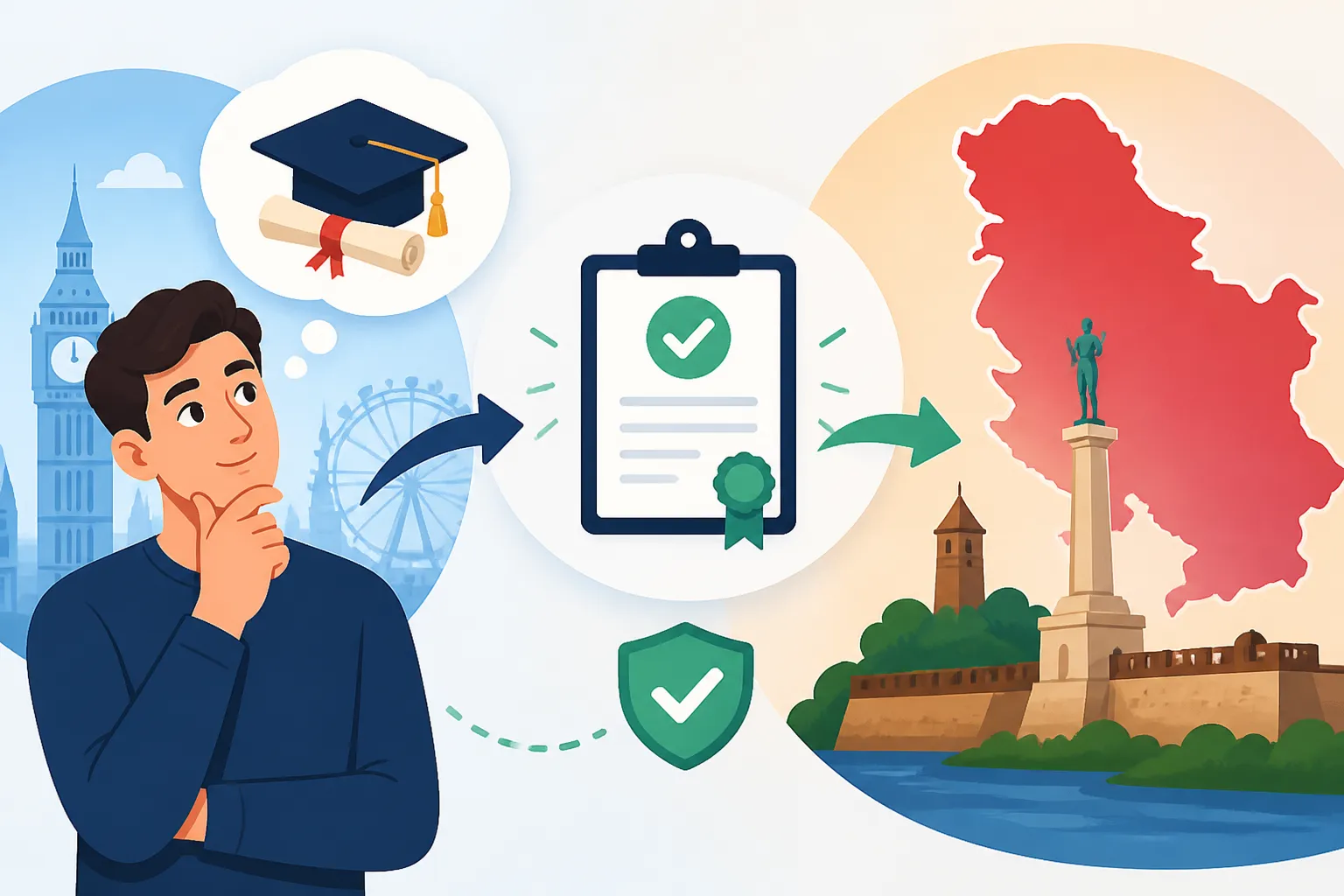
How Do I Get My UK Degree Recognised in Serbia?
Trying to start a new life or advance your career in Serbia with a university degree earned in the UK often hits an unexpected wall: the baffling process of degree recognition. It's a bureaucratic labyrinth that many expats find incredibly frustrating, feeling like their hard-earned qualifications are suddenly questioned. This guide will meticulously break down how to get your UK degree officially recognised in Serbia, helping you navigate the sometimes-confusing steps and avoid common pitfalls so you can finally put your education to good use here.
The Initial Shock: Why Degree Recognition Matters in Serbia
You’ve arrived in Serbia, perhaps brimming with enthusiasm, ready to tackle the local job market or continue your studies. You’ve got your degree certificate in hand, a testament to years of hard work, sleepless nights, and significant financial investment. Then, the reality hits: that piece of paper, so universally accepted back home, is often just that – a piece of paper – until it goes through a process called nostrifikacija here in Serbia. It’s a moment of truth, and often, a moment of profound exasperation for many of us who’ve been through it.
Navigating the Serbian Bureaucracy with Your Qualifications
The Serbian administrative system, God love it, operates on its own unique rhythm and logic. What might be straightforward in the UK often involves multiple stamps, various offices, and a patience level you didn't know you possessed here. When it comes to your degree, it's not simply about showing your certificate; it's about translating it into a language and format that the Serbian system understands and accepts as equivalent to its own educational standards. This isn't unique to Serbia, of course, but the specific steps and the sheer amount of paperwork can be daunting. You'll quickly realise that an unofficial translation simply won't cut it, and every document needs to be presented just so.
Many of us arrive thinking our British education speaks for itself, only to find that formal recognition is a non-negotiable step for many professional roles, especially those in regulated fields like medicine, law, or engineering, but increasingly for any position requiring a university qualification. Even for roles where it's not strictly legally mandated, having your degree recognised can significantly boost your credibility and simplify future administrative tasks. It shows you've gone the extra mile to integrate and conform to local requirements, which can be a subtle but powerful advantage in the job market. This process is a crucial step towards The Complete Guide to Working in Serbia as a Foreigner (2027) or exploring Self-Employment in Serbia: The Pausal Regime and Going Independent (2027).
The Legal Requirement for Nostrifikacija
Nostrifikacija isn't just a suggestion; for many purposes, it's a legal imperative rooted in Serbian law. The Ministry of Education, Science and Technological Development is the central authority governing the recognition of foreign higher education qualifications. The process aims to determine if your UK degree is equivalent to a corresponding Serbian degree in terms of its level, scope, and acquired competencies.
Without this official recognition, your UK degree might hold little weight for formal employment, further education, or even certain residency applications. For example, if you're looking to work in a public sector job or any role that requires professional licensing, you absolutely must have your degree recognised. Even in the private sector, while some companies might be more flexible, many will still prefer or require nostrification to ensure compliance with local labour laws and to easily verify your credentials. Imagine getting a fantastic job offer, only to hit a wall because your degree isn't officially recognised – it's a frustration we want to help you avoid entirely. This also ties into the broader topic of How to Get Your Foreign Qualification Recognised in Serbia, which covers the general framework for all foreign degrees.
Understanding the Nostrifikacija Process for UK Degrees
The journey to getting your UK degree recognised in Serbia involves a few key players and a structured process that, once understood, becomes less mysterious. It's not a free-for-all; there are specific channels to go through, and knowing them upfront can save you a world of headaches.
The Role of ENIC/NARIC Centres
Before you even think about submitting documents to the Serbian Ministry, you’ll likely interact with an ENIC/NARIC centre. For UK degrees, the primary reference point is usually the UK ENIC (European National Information Centre / National Academic Recognition Information Centre). These centres are designated national bodies that provide information and advice on the recognition of academic and professional qualifications. While they don't perform the nostrifikacija itself for Serbia, they often provide statements of comparability that are immensely helpful, sometimes even required, by the Serbian authorities.
A statement from UK ENIC can clarify the level of your UK qualification within the European Qualifications Framework (EQF) and how it compares to the Serbian National Qualifications Framework. This can streamline the initial assessment phase in Serbia, as it provides a universally accepted comparison. Think of it as a helpful translator for your degree's standing in an international context. While not always mandatory for the Serbian process, having this document can certainly smooth things over and provide a clear, independent assessment of your qualification. It's an investment that can pay off in clarity and reduced back-and-forth later on.
Step-by-Step Application with the Serbian Ministry of Education
Once you have your UK degree and all supporting documents (which we'll delve into in the next section), the core of the nostrifikacija process happens at the Serbian Ministry of Education, Science and Technological Development (Ministarstvo prosvete, nauke i tehnološkog razvoja). They are the ultimate authority.
Here's a general outline of the steps:
- Gather Required Documents: This is arguably the most critical and often the most time-consuming step. You'll need original diplomas, transcripts, proof of study, curriculum details, and more.
- Official Translations and Legalisation: Every single document that isn't already in Serbian must be translated by a sworn court interpreter in Serbia. After translation, some documents might require further legalisation, such as an Apostille stamp, especially if they are public documents.
- Complete the Application Form: The Ministry will have a specific application form you need to fill out. Be precise and thorough; any missing information can cause significant delays.
- Pay Administrative Fees: Yes, bureaucracy comes with a price tag. There will be fees associated with the application itself, which can vary depending on the type of qualification and the complexity of the assessment.
- Submit the Application: You'll submit your complete dossier to the Ministry. This is usually done in person or via registered mail. Make sure to keep copies of everything you submit, and get a confirmation of receipt if submitting in person.
- Assessment Process: The Ministry will then review your documents. They will assess the curriculum, the number of ECTS credits, the duration of study, and the learning outcomes of your UK degree against comparable Serbian programmes. This is where patience truly becomes a virtue. The assessment can take several weeks, sometimes even months, depending on the workload and the specific institution.
- Decision and Certificate: If successful, the Ministry will issue a decision recognising your UK degree as equivalent to a Serbian one. You will then receive a certificate of recognition (Uverenje o priznavanju strane visokoškolske isprave). This certificate is your golden ticket.
It's important to remember that this is an administrative process, not an academic re-evaluation. They are looking for equivalence, not judging the quality of your education, which in the UK is generally held in very high regard. The goal is simply to fit it into the Serbian framework. Knowing how Understanding How to Move to Serbia Legally from Abroad (2027) can provide context for this and other administrative hurdles.
Essential Documents and What They Mean
Alright, let's talk about the paperwork. This is where most people get tangled up, and honestly, it’s understandable. The requirements can feel like an endless checklist, but getting it right the first time will save you immense frustration later.
Gathering Your Academic Arsenal
For your UK degree recognition, you'll need to prepare a comprehensive set of documents. Don't skip any, and make sure they are originals or certified copies where specified.
Here’s a typical list:
- Original Degree Certificate (Diploma): This is your main qualification document. Make sure it’s the original or a certified true copy.
- Original Academic Transcript/Record of Studies: This is crucial. It details all the courses you took, the grades you received, the ECTS credits (if applicable), and the duration of your study. Without this, the Ministry can’t properly assess the content of your degree.
- Curriculum/Programme of Study: Sometimes called a diploma supplement, syllabus, or course catalogue. This document outlines the content of your degree programme, specific modules, learning outcomes, and the number of contact hours or credits for each. The more detailed this is, the easier it is for the Serbian authorities to compare it to their own programmes.
- Proof of Identity: A copy of your passport or national ID card.
- Proof of Payment of Fees: Receipts for the administrative fees you've paid to the Ministry.
- Statement of Comparability (optional but highly recommended): As mentioned, a statement from UK ENIC can be very beneficial. While not always strictly mandatory, it can significantly speed up the assessment by providing a clear, internationally recognised comparison of your qualification.
- Proof of Name Change (if applicable): If your name on your degree documents differs from your current legal name, you’ll need official documents (e.g., marriage certificate, deed poll) explaining the change.
It is absolutely vital that these documents are accurate and complete. If something is missing or unclear, the Ministry will send your application back, leading to inevitable delays. Always assume they need more detail, not less. This part of the process really makes you appreciate the simplicity of just handing over a CV for How to Adapt Your CV for the Serbian Job Market.
Translation, Notarisation, and Apostille: The Unavoidable Hurdles
This is where the real administrative fun begins, and it's often the part that catches newcomers off guard.
-
Sworn Court Translator (Sudski Tumač): Any document that is not originally in Serbian must be translated by a sworn court translator in Serbia. You cannot use a translator from your home country, nor can you use a regular translation service unless they are officially recognised by a Serbian court. These translators affix their official stamp and signature, verifying the accuracy of their translation. You'll find many such translators in Belgrade and Novi Sad, often specialising in English. Expect to pay per page for these services, so factor that into your budget.
-
Notarisation: In some cases, particularly for copies of original documents, you might be asked for notarisation. This is usually done by a public notary (javni beležnik) in Serbia, who verifies that a copy is a true likeness of the original. Always clarify if notarised copies are required instead of just photocopies.
-
Apostille (Hague Apostille Convention): This is a critical step for public documents originating from the UK. The UK is a signatory to the Hague Apostille Convention, as is Serbia. This means that instead of a lengthy legalisation chain, a single Apostille stamp from the relevant authority in the UK (usually the Foreign, Commonwealth & Development Office) is sufficient to legalise your document for use in Serbia. Your degree certificate and academic transcripts, being public documents, will almost certainly require an Apostille from the UK. This stamp authenticates the signature and seal of the official who issued the document. Do not confuse this with notarisation or translation in Serbia. The Apostille must be obtained in the country where the document was issued (i.e., the UK, for your UK degree documents) before you bring them to Serbia for translation. Failing to get an Apostille in the UK is a common mistake that can halt your application dead in its tracks and force you to send documents back home, causing significant delays and additional costs.
Here’s a quick summary table for clarity:
| Document Type | Requirement for Serbian Recognition | Where to Obtain/Perform |
|---|---|---|
| Original Degree/Diploma | Mandatory (original or certified copy) | UK University |
| Academic Transcript | Mandatory (original or certified copy) | UK University |
| Curriculum/Syllabus | Mandatory (detailed content) | UK University |
| Proof of Identity | Mandatory (copy of passport/ID) | Your possession |
| Apostille Stamp | Mandatory for public documents (degree, transcript) | UK (Foreign, Commonwealth & Development Office) |
| Sworn Translation | Mandatory for all non-Serbian documents, post-Apostille if applicable | Serbia (Officially appointed court translator/Sudski Tumač) |
| Notarisation of Copies | Sometimes required | Serbia (Public Notary/Javni Beležnik) |
Potential Roadblocks and How to Overcome Them
As with any bureaucratic process, especially in a new country, you're bound to hit a few bumps in the road. Knowing what to expect can help you navigate these challenges with a bit more grace (and less hair-pulling).
Dealing with Discrepancies and Missing Information
One of the most common issues arises from differences between the UK and Serbian education systems. For instance, the credit system, grading scales, or even the structure of a degree programme might not perfectly align. If the Ministry identifies discrepancies or feels that essential information is missing from your curriculum or transcripts, they will contact you. This could mean:
- Request for Additional Documentation: They might ask for more detailed course descriptions, evidence of practical training, or clarification on specific modules. The more comprehensive your initial submission of the curriculum, the less likely this is.
- Contacting Your University: In some cases, the Ministry might directly contact your UK university to verify information or request further details. This can add significant time to the process, as international communication takes its course.
- Supplementary Exams/Courses: In rare instances, if a significant difference is found between your UK degree and its Serbian equivalent, you might be asked to pass supplementary exams or complete additional courses at a Serbian university. This is typically for highly specialised or regulated fields where specific knowledge is deemed absolutely essential by Serbian standards. While this is less common for general degrees from reputable UK institutions, it's a possibility to be aware of.
To mitigate these, make sure your initial submission is as thorough as possible. If you anticipate any potential grey areas in your qualification, it’s always better to provide extra documentation upfront. Proactivity is your best friend here. Consider consulting with an educational advisor or a legal professional specialising in immigration or education law in Serbia if you're particularly worried about your specific case. They can offer invaluable insights and assistance.
Common Delays and Patience is a Virtue
The Serbian administrative machine, while improving, isn't known for its lightning speed. The nostrifikacija process can take anywhere from a few weeks to several months, and sometimes even longer in complex cases. Factors contributing to delays include:
- Volume of Applications: The Ministry processes numerous applications, and peak times can lead to backlogs.
- Complexity of Your Degree: Highly specialised degrees or those from lesser-known institutions (though unlikely for UK degrees) might require more extensive review.
- Communication Lag: If the Ministry needs to communicate with your UK university, international postal and email exchanges can introduce significant delays.
- Incomplete Submissions: As mentioned, any missing document or incorrect translation will send your application back to you, adding weeks or months.
What can you do?
- Start Early: Begin the process as soon as you know you'll need degree recognition. Don't wait until you have a job offer in hand.
- Follow Up Politely: After a reasonable waiting period (e.g., 4-6 weeks after submission), a polite inquiry about the status of your application is acceptable. However, avoid constant nagging; it rarely speeds things up and can be counterproductive.
- Keep Copies: Always, always keep notarised copies of every single document you submit and track all communication. This is your safeguard.
- Have a Backup Plan: If your job search hinges on recognised qualifications, be prepared for potential delays and explore temporary work options or roles where recognition isn't immediately critical.
This process is a marathon, not a sprint. Take a deep breath, prepare thoroughly, and accept that delays are sometimes part of the journey. While waiting, you might find it useful to dive into other aspects of Learning About Living and Working in Serbia: A Complete Guide for Expats.
Life After Recognition: What's Next for Your Career
Congratulations! You've navigated the bureaucratic maze, and your UK degree is officially recognised in Serbia. This is a huge milestone and opens up a host of new possibilities for your life and career here.
Job Hunting and Professional Licensure
With your degree officially recognised, you are now on a much more even playing field with local graduates. You can confidently apply for jobs that explicitly require a Serbian-equivalent university degree. This means wider opportunities across various sectors, including the public sector, which might have previously been off-limits. You can now present your qualification to potential employers without the ambiguity of "foreign degree, pending recognition." This is particularly impactful for How to Get Hired by a Tech or IT Company in Serbia or for pursuing more traditional corporate roles.
For certain professions, particularly those that are regulated (e.g., doctors, engineers, architects, lawyers), degree recognition is only the first step. You will also need to apply for specific professional licenses or registrations with the relevant professional chambers or bodies in Serbia. For example, a doctor with a recognised UK medical degree would then need to register with the Serbian Medical Chamber to practice. These processes often have their own set of requirements, which might include internships, further exams, or proof of language proficiency. Make sure to research the specific requirements for your profession well in advance. Having your degree recognised is a necessary foundation for these next steps. This also makes it easier to navigate The Expat Guide to Finding a Job in Serbia (2027).
Continuing Education and Language Skills
Your recognised degree also paves the way for further academic pursuits in Serbia. If you ever consider postgraduate studies, PhD programmes, or even specialised training courses, your validated degree will be accepted by Serbian universities as a prerequisite. This means you can seamlessly integrate into the Serbian academic landscape if you choose to.
Beyond formal qualifications, truly integrating into the Serbian professional world often benefits immensely from local language skills. While many international companies operate in English, especially in the thriving tech and IT sectors, being able to communicate in Serbian significantly broadens your job prospects and enhances your daily life. It shows commitment and helps you build deeper connections with colleagues and clients. Consider taking Serbian language classes; platforms like iTalki offer flexible online lessons with native speakers, which can be a fantastic way to improve your conversational skills and understand cultural nuances. The investment in language is an investment in your future in Serbia.
Furthermore, once you start earning in Serbia, understanding the local tax system becomes paramount. Resources like Taxes for Expats can provide invaluable guidance on navigating income tax, social contributions, and other financial obligations. Even with a flat 10% income tax, there are nuances to consider, especially if you have foreign income sources. Proper financial planning goes hand-in-hand with career progression, so don’t overlook this crucial aspect after your degree is recognised. This will help you understand The Complete Guide to Taxes in Serbia for Expats (2027) and Understanding Income Tax and the Flat 10% Rate in Serbia (2026).
Disclaimer
Please remember that this guide provides general information based on current practices and regulations in Serbia concerning the recognition of foreign higher education qualifications. Laws and administrative procedures can change. While every effort has been made to ensure accuracy, this information should not be taken as legal advice. It is always recommended to consult directly with the Serbian Ministry of Education, Science and Technological Development or a qualified legal professional for advice tailored to your specific situation and for the most up-to-date requirements.